Hello, I’m Hirossy.
When you hear “Japanese winter,” what kind of image do you have?
“Does it snow a lot in Japan?”
“Are Japanese homes warm in winter?”
“How do Japanese people stay warm?”
Some people from other countries may wonder about these things.
Winter in Japan is very different depending on the area.
In Hokkaido and some areas near the Sea of Japan, it can snow a lot.
But in Tokyo and many areas on the Pacific side, there are years when it does not snow much.
Still, many Japanese people have some common ways to enjoy winter more comfortably.
We use warm clothes, heaters, warm food, and old ideas from daily life.
In this article, I will share Japanese winter life from my view as an ordinary Japanese dad.
- Japanese Winter Is About Finding Small Ways to Stay Warm
- Winter in Japan Is Very Different by Area
- Japanese Homes Can Feel Colder Than Expected
- Winter Clothes in Japan: Keep Your Neck, Hands, and Head Warm
- Kotatsu: A Famous Part of Japanese Winter Culture
- Winter Food: Hot Pot Is a Family Favorite
- Japanese Winter During Travel
- Friendly Advice for Visiting Japan in Winter
- Conclusion: Japanese Winter Has Warmth Inside the Cold
Japanese Winter Is About Finding Small Ways to Stay Warm
In Japan, many people spend winter by finding small ways to stay warm and comfortable.
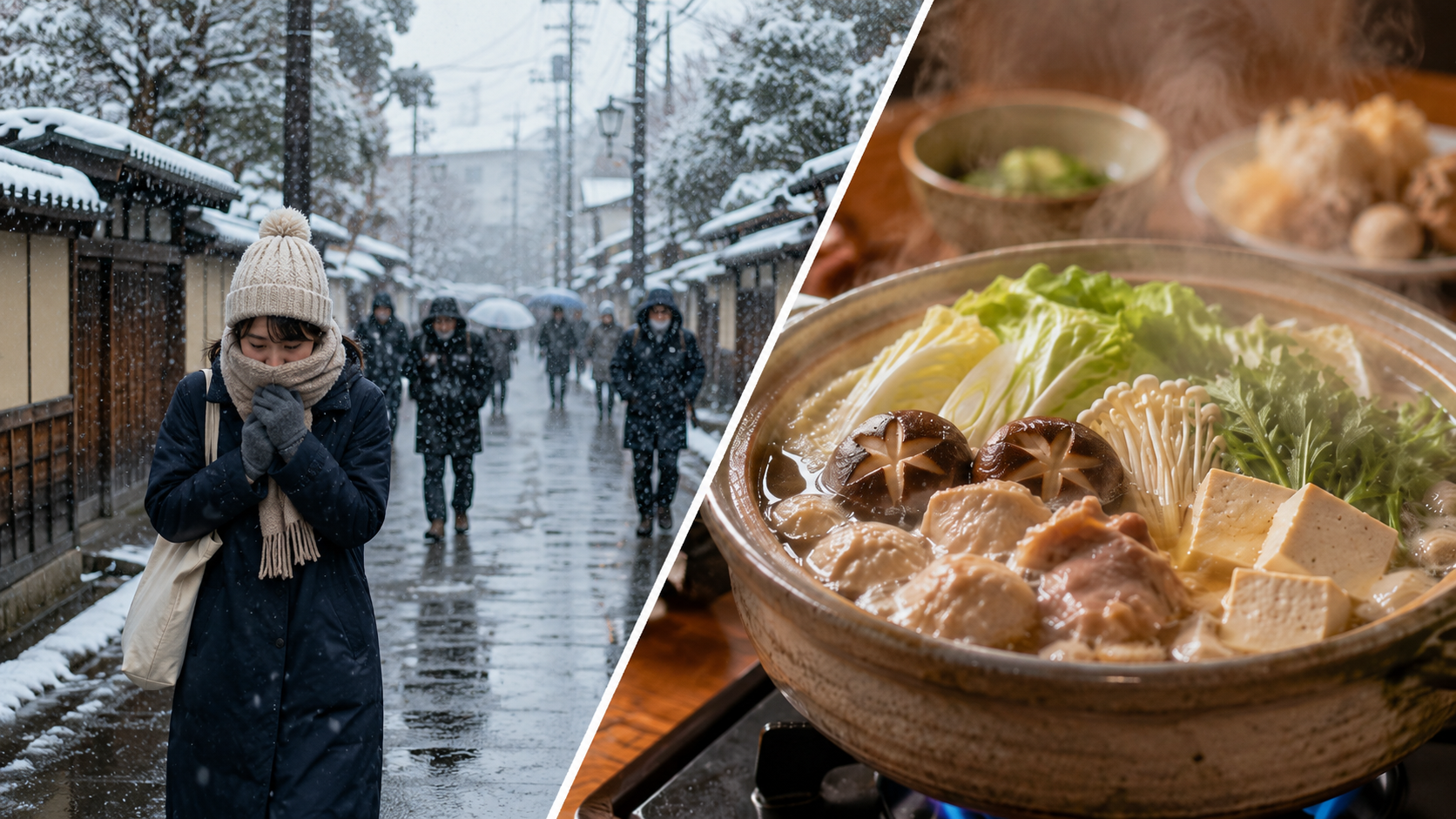
When we go outside, we often wear a jacket, a knit cap, gloves, and a neck warmer.
For me, when my neck gets cold, my whole body feels cold.
So I often use a neck warmer in winter.
Also, when my ears get cold, they sometimes hurt.
So a knit cap that covers my ears is very helpful.
At home, many families use an air conditioner as a heater.
In my family, we also use an air conditioner for heating in winter.
When people talk about Japanese winter, they may also think of kotatsu and hot pot dishes.
I think both of them show the feeling of winter at home in Japan.
Of course, every family and area is different.
But in Japan, winter is not only about “enduring the cold.”
It is also about finding small ways to enjoy the cold season more comfortably.
Winter in Japan Is Very Different by Area
Japan is a long country from north to south, so winter is very different depending on the area.
In Hokkaido, Tohoku, and some areas near the Sea of Japan, it can snow a lot.
On the other hand, in big cities like Tokyo, Osaka, and Nagoya, there are not many snowy days.
Some people from other countries may imagine that Japanese winter always means snowy scenery.
Yes, some areas have a lot of snow.
But all of Japan is not covered with snow every winter.
From my experience, when it snows, children are very happy.
They look outside and say, “Snow!” with excitement.
But adults may feel a little differently.
Snow can make commuting harder.
Roads can become slippery.
Morning preparation can take more time.
To be honest, for adults, snow is beautiful, but it can also be a little troublesome.
This may be one difference between children and adults in winter.
Japanese Homes Can Feel Colder Than Expected
If you spend winter in Japan, one thing may surprise you.
Some Japanese homes can feel colder than you expect.
Of course, many newer homes are better at keeping heat inside.
But in older houses and apartments, people often heat only the room they are using.
The whole house is not always warm.
For example, the living room may be warm because the air conditioner is on.
But the hallway, toilet, or changing room may be cold.
This is quite common in many Japanese homes.
In Japan, many families do not heat the whole house with central heating.
Instead, they often heat one room at a time.
Because of this, it is hard to get out of bed on winter mornings.
I think this is a very common winter experience in Japan.
When my futon is warm in the morning, I do not want to leave it.
Children feel this way, and adults feel it too.
A warm futon in winter is very powerful.
Winter Clothes in Japan: Keep Your Neck, Hands, and Head Warm
When people go outside in winter, many Japanese people wear warm clothes.
For me, I use a jacket, a knit cap, gloves, and a neck warmer.
I especially think the neck is important.
When your neck is cold, your whole body feels cold.
But if you warm your neck with a neck warmer or scarf, you can feel much better.
For people who go to work or school, winter mornings can be very cold.
If you walk to the station or ride a bicycle, gloves are also very important.
In Japan, you can buy winter items easily at convenience stores, supermarkets, and clothing stores.
So if you visit Japan in winter, you can also buy some warm items after you arrive.
But if you are going to a very cold area, it is better to prepare well before you go.
Kotatsu: A Famous Part of Japanese Winter Culture
One winter culture I want people from other countries to know is kotatsu.
A kotatsu is a low table with a thick blanket around it.
There is a heater under the table, so the inside becomes warm.
When you put your legs inside, it feels very comfortable.
I think kotatsu is a very Japanese winter item.
Many people imagine sitting in a kotatsu, eating mandarin oranges, watching TV, and relaxing with family.
It is a classic winter scene in Japan.
However, not every family has a kotatsu.
Some families do not use one because it takes up space.
Some families use only an air conditioner or floor heating.
In my family, we use an air conditioner for heating.
But I still think kotatsu culture is very interesting when talking about Japanese winter.
A kotatsu is so comfortable that once you get inside, you do not want to leave.
So “I cannot get out of the kotatsu” is a common winter joke in Japan.
Winter Food: Hot Pot Is a Family Favorite
One food many Japanese people want to eat in winter is hot pot, called nabe in Japanese.
I love nabe.
Nabe is very simple.
You cut vegetables, meat, fish, tofu, and other ingredients.
Then you put them into a pot and cook them together.
It is not too difficult to make.
It warms your body, and you can eat a lot of vegetables.
So I think it is also good for health.
In Japan, there are many kinds of ready-made nabe soup bases.
At supermarkets, you can find soy sauce flavor, miso flavor, kimchi flavor, soy milk flavor, and many more.
If you change the soup base, the taste becomes different even with the same ingredients.
So you can eat nabe many times in winter without getting bored.
Eating from the same pot with family feels very warm and winter-like.
Of course, every family has different favorite flavors and ingredients.
But nabe is one of the foods that shows Japanese winter at home.
Japanese Winter During Travel
If you travel in Japan during winter, you may see many winter things in daily life.
At convenience stores, you can find hot drinks.
Canned coffee and tea are often sold warm.
When you walk outside on a cold day, buying a hot drink at a convenience store can make you feel relaxed.
In winter, some convenience stores also sell nikuman and oden.
Nikuman is a warm steamed bun with meat inside.
Oden is a Japanese dish with daikon radish, eggs, konjac, and fish cakes cooked in a light soup.
Oden is one of the foods that feels very Japanese in winter.
In towns and cities, you may see people wearing scarves, coats, and gloves.
You may also see people waiting for trains in the cold.
Some tourist spots have beautiful winter illuminations.
Japanese winter is cold, but you can also enjoy warm food and beautiful scenery.
Friendly Advice for Visiting Japan in Winter
If you visit Japan in winter, it is good to think about your clothes depending on the area.
Even in cities like Tokyo and Osaka, mornings and nights can feel very cold.
The daytime may be a little warmer, but the temperature can drop at night.
A knit cap, gloves, scarf, or neck warmer can be useful.
If you plan to walk outside for a long time, keeping your neck and hands warm is a good idea.
If you go to a snowy area, shoes that are not slippery are also important.
In snowy places, the roads can become icy.
Also, in Japanese homes and hotels, some rooms may feel warmer than others.
A light jacket for indoors and warm socks can help you feel comfortable.
And if you have a chance, please try nabe or experience kotatsu culture.
Eating nabe at a restaurant can be fun.
And if you can sit in a kotatsu at a hotel or a traditional place, you may feel a special part of Japanese winter.
Conclusion: Japanese Winter Has Warmth Inside the Cold
Japanese winter is very different depending on the area.
Some places have a lot of snow.
Some places have almost no snow.
Also, homes in Japan may feel a little cold compared with homes in some other countries.
But Japanese winter has many small ways to stay warm and comfortable.
We warm the room with an air conditioner.
We wear jackets, gloves, and neck warmers outside.
We warm our legs in a kotatsu.
We eat nabe with family and warm our bodies from the inside.
Children may be excited when they see snow.
Adults may worry about commuting.
I think this small difference is also a part of everyday winter life in Japan.
Japanese winter is not only cold.
Because it is cold, we can enjoy warm family time, warm food, and small comforts.
I hope this article helps you feel a little closer to winter life in Japan.
Comments