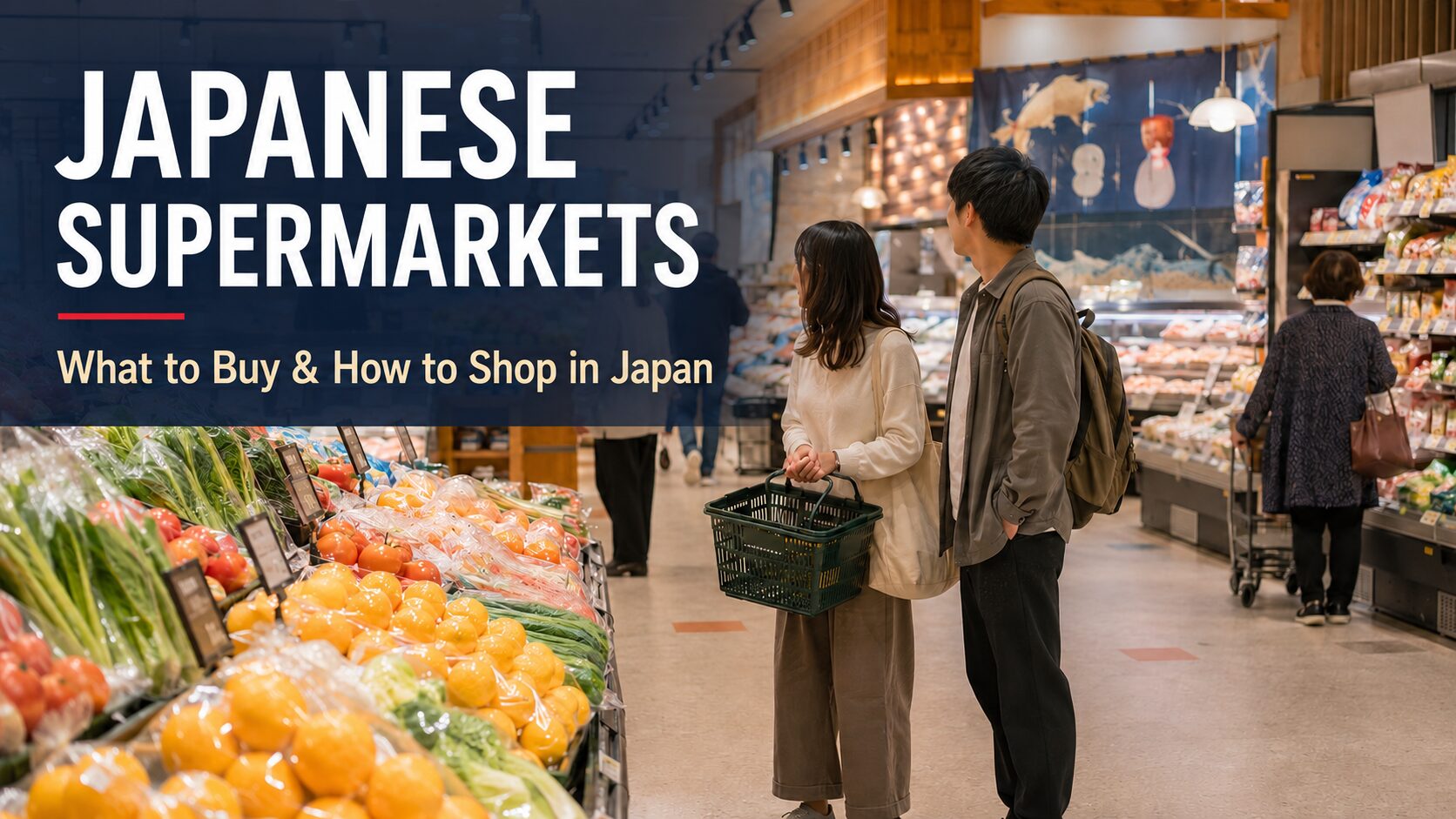
When you travel in Japan, try visiting a local supermarket, not only a convenience store.
A Japanese supermarket is more than a place to buy food. By looking at prepared dishes, sashimi, thinly sliced meat, snacks, and other products, you can learn what people in Japan eat in their daily lives.
It is a place where you can see ordinary life in Japan, away from famous tourist spots.
In this guide, I will introduce what to look for in a Japanese supermarket and explain some points that may confuse first-time visitors. I live in Japan and regularly go grocery shopping with my family, so I will also share some of my own experiences.
- What to Look for in a Japanese Supermarket
- Prepared Food and Bento Are Useful During a Trip
- The Seafood Section Shows Japan’s Fish Culture
- Buy Sashimi Near the End of Your Shopping Trip
- Thinly Sliced Meat Is Common in Japan
- My Children Go Straight to the Snack Aisle
- My Easy Recommendation: Instant Miso Soup
- Evening Discount Stickers
- Useful Japanese Words in a Supermarket
- Payment Methods Depend on the Store
- How to Use Self-Checkout
- Shopping Bags and Packing Your Food
- Supermarket or Convenience Store?
- Japan Has Many Regional Supermarkets
- Important Tips for Foreign Visitors
- Frequently Asked Questions
- Final Thoughts
- Sources
What to Look for in a Japanese Supermarket
If this is your first visit to a Japanese supermarket, these sections are worth checking.
| Section | What You May Find |
|---|---|
| Prepared food and bento | Karaage, croquettes, tempura, grilled fish, boxed meals |
| Seafood | Sashimi, sushi, seasonal fish, whole fish |
| Snacks | Gummies, rice crackers, chocolate, regional products |
| Drinks | Japanese tea, coffee, milk drinks, seasonal drinks |
| Packaged food | Cup noodles, ready-made curry, furikake, instant miso soup |
| Local products | Regional sauces, noodles, snacks, and produce |
I especially recommend the prepared food, bento, and seafood sections.
These areas show not only Japanese food culture, but also what families and people coming home from work often buy.
Prepared Food and Bento Are Useful During a Trip
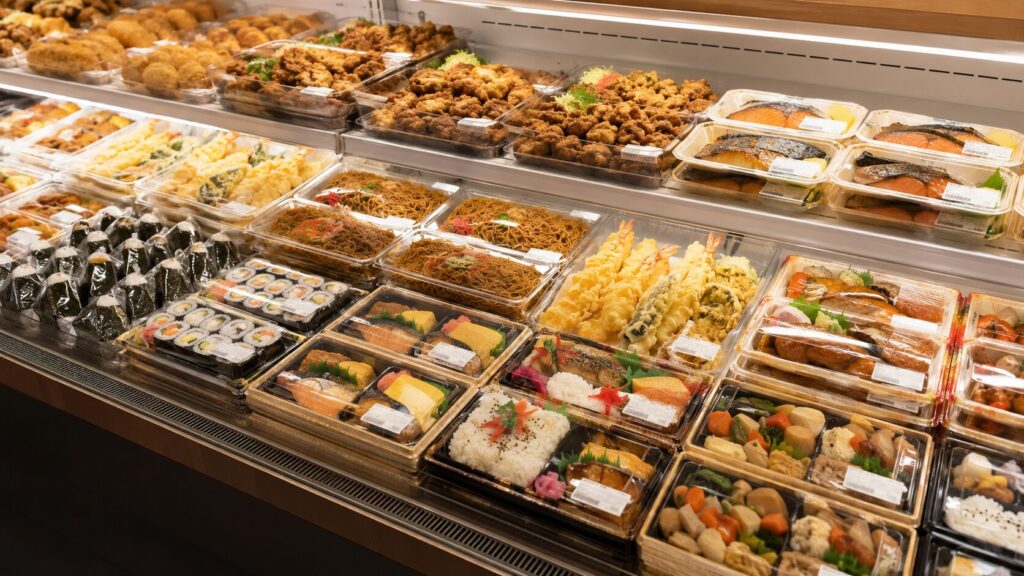
Japanese supermarkets usually have a wide range of prepared dishes and bento.
The selection depends on the store and the time of day, but you may find:
- Karaage, or Japanese fried chicken
- Croquettes
- Tempura
- Grilled fish
- Simmered dishes
- Rice balls
- Yakisoba
- Sushi
- Bento meals
You can try everyday Japanese food without going to a restaurant.
You can buy one complete bento, or choose several small dishes that look interesting. This is useful when you are tired after sightseeing or when you want to eat a quiet dinner in your hotel room.
Some food may need to be heated. Before buying it, check whether your hotel has a microwave. Some supermarkets have microwaves for customers, but not every store does.
The Seafood Section Shows Japan’s Fish Culture
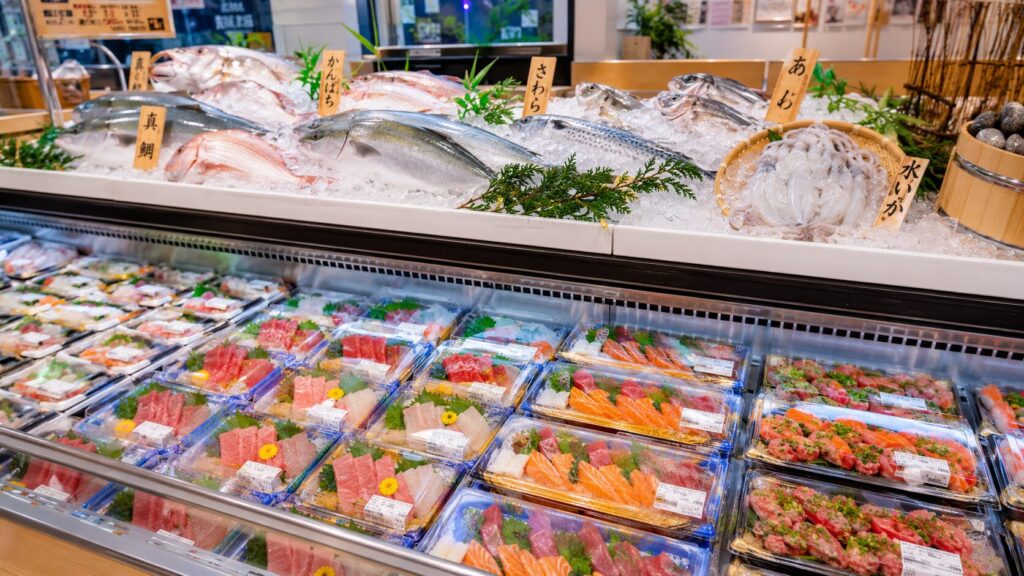
The fresh seafood section is one of the places I most want foreign visitors to see.
Japanese supermarkets often sell more than packaged sashimi and sushi. Many also sell fish that still needs to be prepared and cooked.
Some supermarkets cut and prepare fish inside the store. You may see whole fish displayed on ice. A few stores even have tanks with live fish.
Of course, not every supermarket has a large seafood section or a fish tank. However, supermarkets near my home often have an impressive selection of fresh seafood.
Common types of sashimi include tuna, salmon, sea bream, yellowtail, and squid. The selection changes depending on the region, season, and daily delivery.
Even if you do not buy anything, the seafood section can show you how closely fish is connected to daily food culture in Japan.
Buy Sashimi Near the End of Your Shopping Trip
Sashimi and sushi are raw foods.
Do not put them in your basket at the beginning and then spend a long time walking around the store. Buy them near the end of your shopping trip.
After paying, keep them cold and return to your hotel or accommodation as soon as possible.
I do not recommend buying sashimi and then carrying it around for several hours while sightseeing.
Some supermarkets provide ice to help keep purchased food cold. If ice is available, follow the instructions near the machine. The rules and purpose of the ice may differ by store.
Small packets of soy sauce and wasabi may be included with sashimi. However, this is not always the case, so check inside the package or around the seafood section before you leave.
Thinly Sliced Meat Is Common in Japan
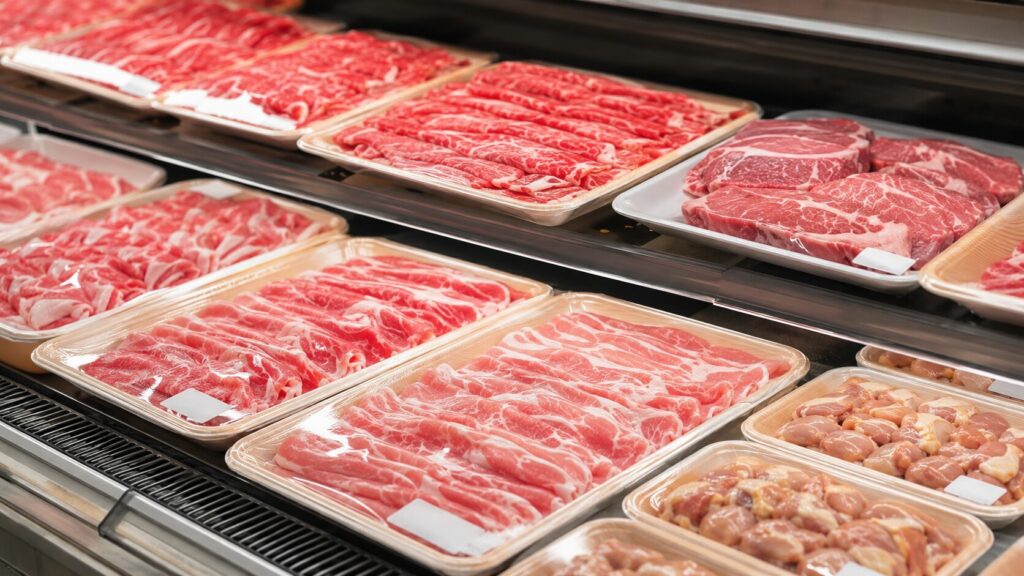
Japanese supermarkets sell beef, pork, and chicken.
However, in the supermarkets near my home, I do not often see the very large and thick steak cuts that are common in some American supermarkets.
Instead, I often see thinly sliced beef and pork. These cuts are useful for Japanese home cooking, such as shabu-shabu, sukiyaki, and stir-fried dishes.
Chicken is also often cut into small pieces, and many types of meat are sold in smaller packages.
When I look at the meat section, I can see how differences in home cooking appear in the way meat is cut and packaged.
You may have better luck finding thick steak cuts at a large supermarket, warehouse-style store, or specialty butcher. However, the selection depends on the store.
My Children Go Straight to the Snack Aisle
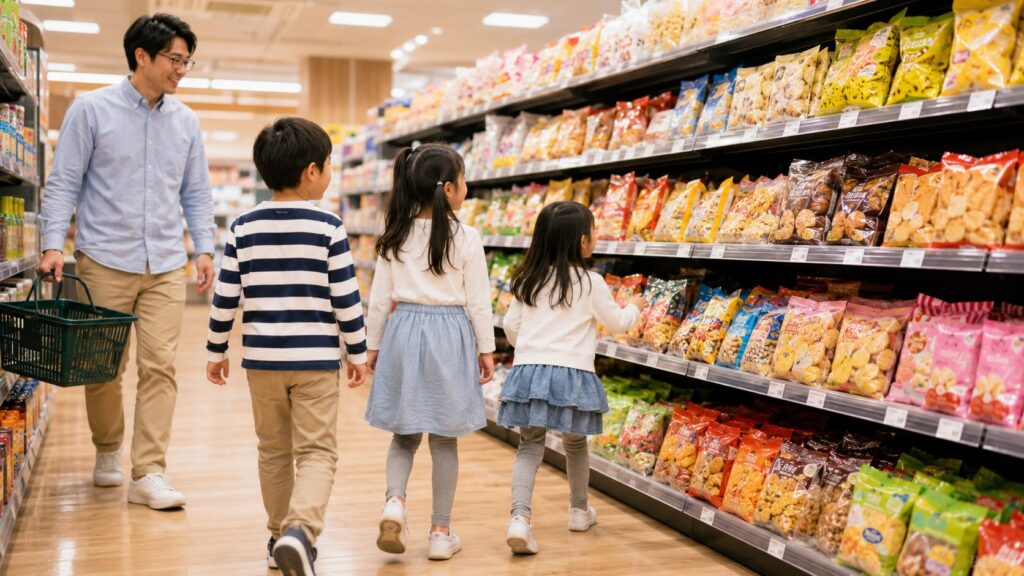
The snack aisle is also worth visiting if you are interested in Japanese food.
You can find chocolate, gummies, rice crackers, candy, potato chips, and many other products. Supermarkets often have larger snack sections than convenience stores. They may also sell family-size bags and multipacks.
Some stores sell regional or seasonal snacks, so supermarkets can be useful places to look for souvenirs.
When I shop with my children, I look at vegetables, fish, and prices. My children walk past those sections and head straight for the snack aisle.
I may be the only person in my family who thinks of the supermarket as a place to learn about Japanese food culture. For my children, it is simply the place where the snacks are.
My Easy Recommendation: Instant Miso Soup
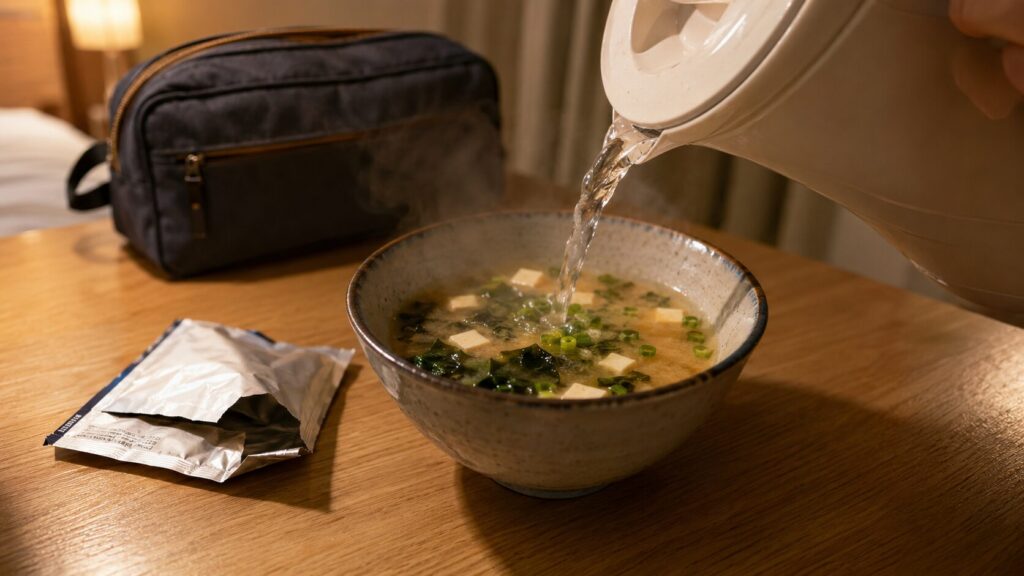
Japanese supermarkets also sell many foods that are easy for travelers to try.
You can often find bottled Japanese tea, cup noodles, ready-made curry, furikake, and instant miso soup.
If I had to recommend only one, I would choose instant miso soup.
You only need to add hot water, so it is easy to prepare if your hotel room has an electric kettle. It is also light, easy to carry, and usually not expensive.
Some people may think instant food always tastes much worse than food made in a restaurant or at home.
Personally, I feel a big difference between ramen from a ramen shop and cup noodles. However, I do not feel such a large difference with miso soup.
Of course, instant miso soup is not exactly the same as homemade miso soup. Still, I think it is an easy and enjoyable way to try a familiar Japanese flavor.
Meat, dairy products, fruit, and some other foods may be restricted when entering another country. Before taking food home, check the customs and quarantine rules of your destination.
Evening Discount Stickers
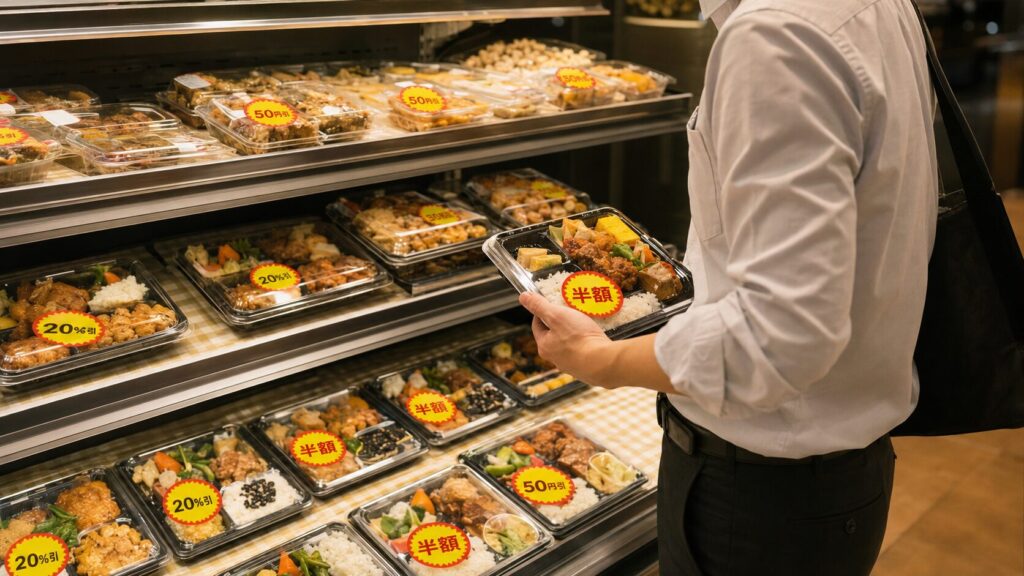
In the evening, Japanese supermarkets sometimes put discount stickers on bento and prepared food.
Here are some common labels.
| Japanese | Meaning |
|---|---|
| 半額 | Half price |
| 20%引 | 20% off |
| 30%引 | 30% off |
| 50円引 | 50 yen off |
| おつとめ品 | An item reduced in price because it should be sold soon |
| 値引品 | Discounted item |
The time and size of the discount depend on the store, day, closing time, and how well the products are selling.
There is no rule that says everything will be half price at 7:00 p.m. Popular items may sell out before they are discounted, or soon after the stickers are added.
When I was single, I often depended on prepared food with discount stickers.
Eating at restaurants regularly was expensive, so I stopped at a supermarket after work and bought discounted dishes to save money on dinner.
On days when I was tired and did not want to cook, these meals gave me a practical way to eat dinner without spending as much as I would at a restaurant.
For that reason, discount stickers are not only a useful travel tip. They are also part of daily life for many people working in Japan.
However, it is better not to hold a product for a long time while waiting for a staff member to add a discount sticker. Choose from the items that have already been reduced.
Useful Japanese Words in a Supermarket
Many products and signs may only be written in Japanese. These words can be useful.
| Japanese | Meaning |
|---|---|
| 惣菜 | Prepared food or side dishes |
| 弁当 | Boxed meal |
| 刺身 | Sliced raw seafood |
| 半額 | Half price |
| おつとめ品 | Reduced-price item |
| レジ | Checkout |
| レジ袋 | Shopping bag |
| 消費期限 | Use-by date |
| 賞味期限 | Best-before date |
“Use-by date” and “best-before date” do not mean the same thing.
消費期限, or shōhi kigen, is a use-by date. It shows how long a food can be eaten safely when it is unopened and stored correctly. It is often used for food that spoils quickly, such as bento and sandwiches.
賞味期限, or shōmi kigen, is closer to a best-before date. It shows how long a product should keep its intended quality and taste when it is unopened and stored correctly. It is often used for snacks, cup noodles, canned food, and other items that keep longer.
After opening a product, eat it as soon as possible, even if the printed date has not passed.
Payment Methods Depend on the Store
Payment methods differ between supermarkets.
Some stores accept credit cards, mobile payments, electronic money, and transportation IC cards. However, not every supermarket accepts the same methods.
Check the payment logos near the entrance, checkout, or payment machine. It is also a good idea to carry a small amount of cash instead of depending only on your phone.
Some supermarkets accept Suica and other transportation IC cards, but not every store does.
If you are also planning to use Suica for trains, you can read my Welcome Suica Mobile guide. However, you should still check whether the supermarket you visit accepts it.
How to Use Self-Checkout
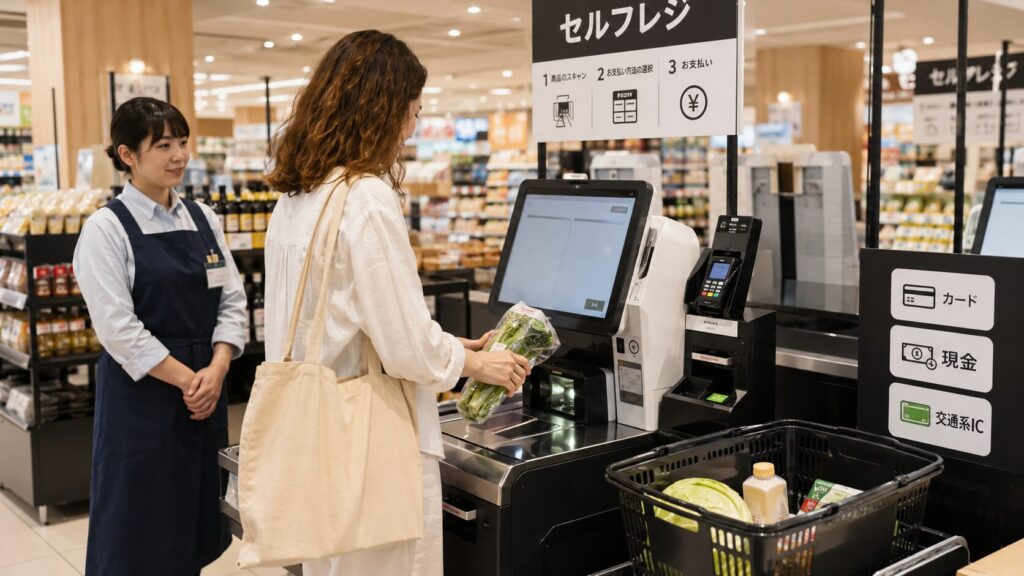
Self-checkout machines have become common in the supermarkets around me.
However, the system is not the same in every store.
The usual process is:
- Press the start button on the screen.
- Scan the barcode on each item.
- Place the item in the designated area if the machine asks you to do so.
- Choose your payment method.
- Pay.
- Take your receipt.
Some machines check the weight of items in the bagging area. Others simply let you scan each product.
Fruit and vegetables without barcodes may need to be selected from the screen. Some machines have an English-language option, while others are only in Japanese.
Do not worry if you need help.
You can say “Sumimasen,” which means “Excuse me,” and point to the screen. A staff member will usually understand that you need help.
Some supermarkets also use semi-self-checkout. In this system, a staff member scans your items, but you use a separate machine to pay.
Shopping Bags and Packing Your Food
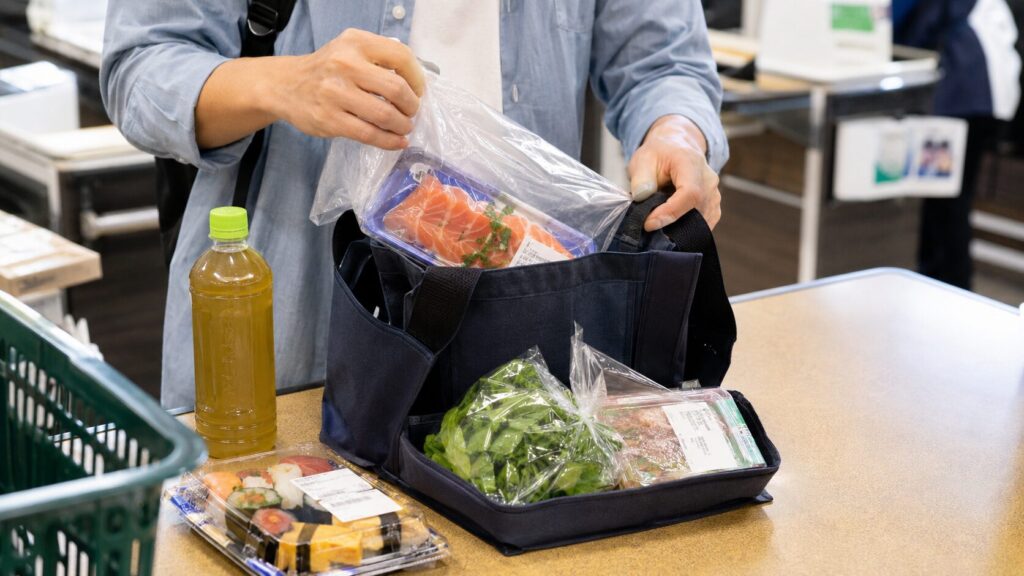
In many Japanese supermarkets, customers pack their own shopping bags after paying.
There is usually a packing table near the checkout area.
Shopping bags may cost extra, so carrying a reusable bag is useful. A bag with a wide, flat bottom is especially helpful for bento, sushi, and sashimi packs.
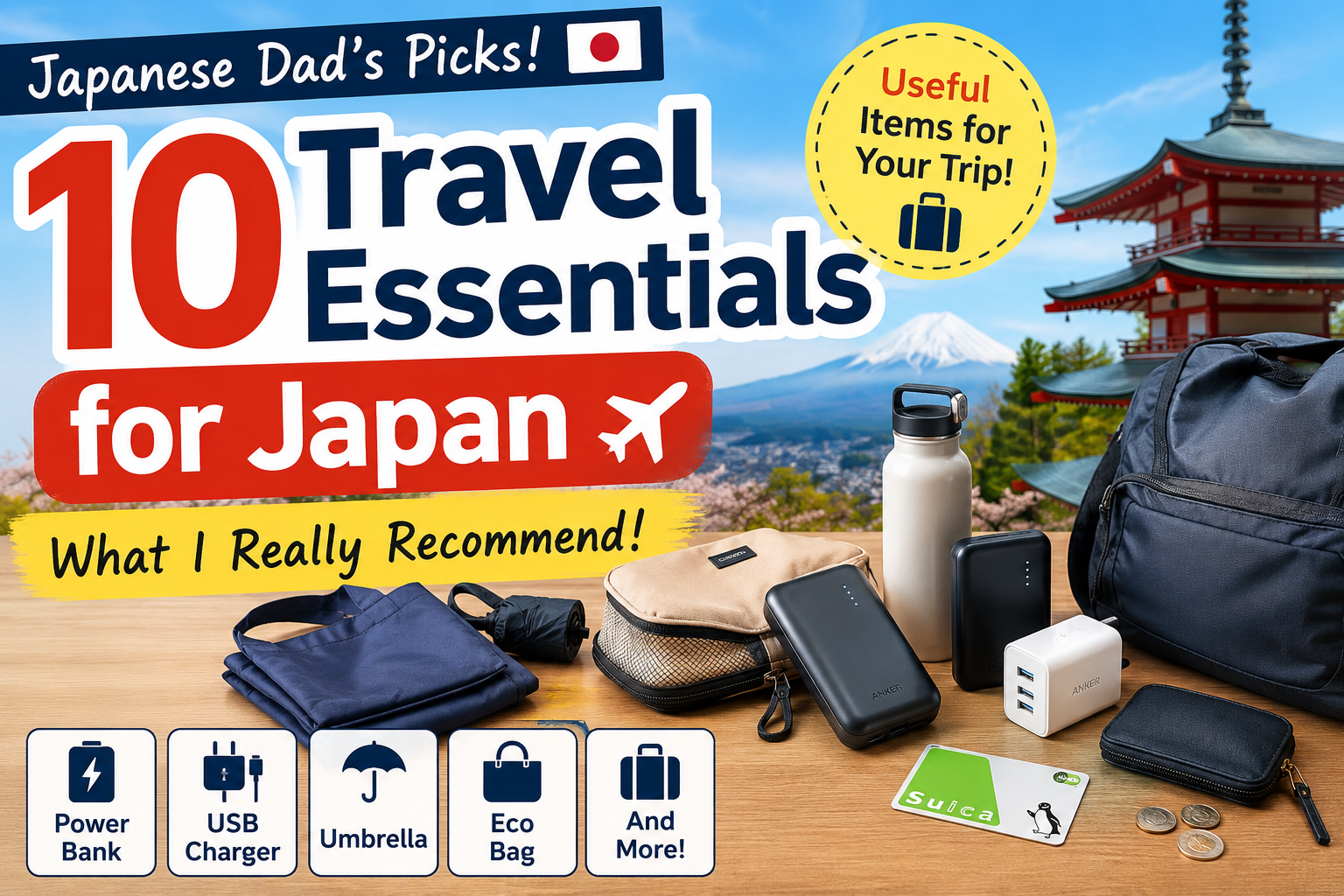
You can find more useful travel items in this guide:
Related article: What to Pack for Japan: 10 Useful Travel Essentials
https://hirossy.jp/what-to-pack-for-japan/
Small clear plastic bags may be available near the meat and seafood sections or at the packing table. You can use them to help prevent leaks from food packages. Take only what you need.
Supermarket or Convenience Store?
Supermarkets and convenience stores are useful for different reasons.
| Purpose | Supermarket | Convenience Store |
|---|---|---|
| Product selection | Wide selection | Smaller, carefully selected range |
| Bento and prepared food | More variety | Quick and easy to buy |
| Opening hours | Depends on the store | Often useful early in the morning or late at night |
| Snacks | More family-size bags and multipacks | More small sizes and new products |
| Best for travelers | Dinner, larger purchases, souvenir shopping | Breakfast, drinks, and quick shopping |
I usually choose a convenience store when I need a drink or a light breakfast quickly.
I choose a supermarket when I want to look at several kinds of prepared food, buy sashimi for dinner, or shop for snacks in larger amounts.
One is not always better than the other. The best choice depends on your schedule and what you need.
Japan Has Many Regional Supermarkets
Japan has large supermarket chains, but it also has many supermarkets that mainly operate in certain regions.
In the area where I live, I often see Valor, Kanesue, and Nafco.
Even supermarkets in the same area can be different. Prices, prepared food, seafood sections, and payment methods may vary.
If you find a supermarket name you do not know during your trip, it may be worth going inside. You might discover local products and see what people in that area usually buy.
Note: The Nafco mentioned here is a food supermarket operated by Tomida mainly in Aichi Prefecture. It is different from the home improvement store chain with the same name.
Important Tips for Foreign Visitors
Do not open or eat products before paying.
Buy sashimi and sushi near the end of your shopping trip, and do not carry them around for a long time after leaving the store.
Check the storage instructions and use-by date on bento and prepared food.
Be careful when taking photos inside a supermarket.
Some stores do not allow photography, while others may require permission. Check for signs and ask a staff member if you are not sure.
Also, try not to include the faces of customers or staff in your photos.
Frequently Asked Questions
Do supermarket staff speak English?
It depends on the store and the staff member.
Outside major tourist areas, English may not always be available. A translation app can help. Pointing to the product or self-checkout screen can also make communication easier.
Can I eat supermarket bento inside the store?
Some supermarkets have eating areas, but many do not.
If you cannot find a clear eating space, do not eat inside the store. Take the food back to your hotel or another place where eating is allowed.
What time do discount stickers appear?
There is no fixed time.
You may see them in the evening, but the timing depends on the store and the day. The item you want may also sell out before it is discounted.
Can I use a credit card or Suica?
Some supermarkets accept them, but payment methods differ by store.
Check the signs near the entrance or checkout. Carrying some cash is also helpful.
What Japanese food should I try first?
If you can eat it soon, I recommend prepared food, bento, or sashimi.
If you need something easy to carry or prepare in your hotel, instant miso soup is also a good choice.
Final Thoughts
A Japanese supermarket is not only a place to buy affordable food.
Prepared dishes and bento show you what people often eat in daily life. The seafood section shows how closely fish is connected to Japanese food culture. Thinly sliced meat also gives you a small look at the way people cook at home.
Discounted prepared food is another part of ordinary life in Japan. When I was single, I often stopped at a supermarket after work and bought it to save money instead of eating at a restaurant.
For my children, however, the supermarket is not a place to learn about Japanese culture. It is the place where they choose snacks.
During your trip, try visiting a regional supermarket as well as famous tourist attractions.
It may not feel like a special sightseeing experience, but it can show you something just as interesting: the everyday life of people in Japan.
Sources
- Ministry of Agriculture, Forestry and Fisheries: Food safety guidance for carrying and storing food
- Ministry of Agriculture, Forestry and Fisheries: Explanation of use-by and best-before dates
- Consumer Affairs Agency: Information about expiration-date labeling
- Kanesue official website: Store information
Opening hours, payment methods, store facilities, and available products may change. Check the signs in the store or the supermarket’s official website when you visit.
Comments