Hello, I’m Hirossy.
If you are planning a trip to Japan, you may wonder:
“How much does the rainy season affect travel in Japan?”
“Is it hard to enjoy Japan during the rainy season?”
In Japan, there is a rainy season between spring and summer.
In Japanese, we call it tsuyu.
Even for people who live in Japan, tsuyu can be a little difficult.
There are many rainy days, and clothes do not dry easily.
The air also becomes very humid.
For me, bad weather can sometimes cause migraines.
So honestly, the rainy season can feel a little depressing.
But if you prepare a little, you can still enjoy traveling in Japan during this season.
Today, I will explain the Japanese rainy season in a simple and friendly way, from the view of an ordinary Japanese dad.
- Conclusion: You Can Enjoy Japan’s Rainy Season with a Little Preparation
- What Is Tsuyu?
- The Hardest Part of Tsuyu Is the Humidity
- Bad Weather Can Affect Some People’s Health
- Rainy Season Scenes You May See in Japan
- Good Things About Japan’s Rainy Season
- Useful Things to Bring During the Rainy Season
- A Flexible Travel Plan Is Better
- Small Rainy-Day Manners in Japan
- Summary: The Rainy Season Is a Little Hard, But It Is Also Part of Japan
Conclusion: You Can Enjoy Japan’s Rainy Season with a Little Preparation
The Japanese rainy season is a time when there are many rainy days in early summer.
The timing is a little different depending on the area.
But in many parts of Japan, especially on the main island, it often happens around June to July.
For travelers, the biggest problem may not be only the rain.
It may be:
humidity
muggy weather
clothes and shoes that do not dry easily
It does not mean that heavy rain falls all day, every day.
Sometimes it is light rain.
Sometimes the rain stops for a while.
But the sky can be cloudy, and rain may suddenly start.
So if you visit Japan during the rainy season, it is helpful to bring a folding umbrella and comfortable shoes.
What Is Tsuyu?
Tsuyu is the season when Japan has many rainy days.
In Japanese, it is written as 梅雨.
These characters mean “plum rain.”
It is said that this name comes from the time when plums grow and rain becomes common.
Tsuyu is not only a special Japanese season.
A similar rainy season can also be seen in some parts of East Asia.
In Japan, during this season, you may often hear these words on the weather news:
“Tsuyu has started.”
“When will tsuyu end?”
Tsuyu-iri means the start of the rainy season.
Tsuyu-ake means the end of the rainy season.
For many Japanese people, when tsuyu ends, it feels like real summer is beginning.
The Hardest Part of Tsuyu Is the Humidity
For many foreign visitors, the surprising part of Japan’s rainy season may not be only the rain.
The hardest part is often the humidity.
Even when it is not raining, the air can feel very damp.
Your clothes may stick to your skin.
Your hair may not stay neat.
Even in a hotel room, washed clothes may not dry quickly.
I also have trouble with laundry during the rainy season.
When you have a family, there is a lot of laundry.
If we cannot dry clothes outside for many days, it becomes a real problem.
I sometimes think, “Maybe the clothes will dry today.”
But then it rains again.
When this continues, my mood becomes a little heavy.
If you plan to wash clothes during your trip, it is good to remember that they may take longer to dry.
Bad Weather Can Affect Some People’s Health
During the rainy season, there is not only rain and humidity.
The air pressure can also change.
Some people may get headaches on bad weather days.
Some people may feel tired or heavy.
For me, bad weather can sometimes cause migraines.
So to be honest, I sometimes feel down during the rainy season.
Of course, this does not happen to everyone.
But if you often get headaches, or if your body is affected by the weather, it may be better not to make your travel schedule too busy.
It is also good to plan some time to rest at a cafe or hotel.
Rainy Season Scenes You May See in Japan
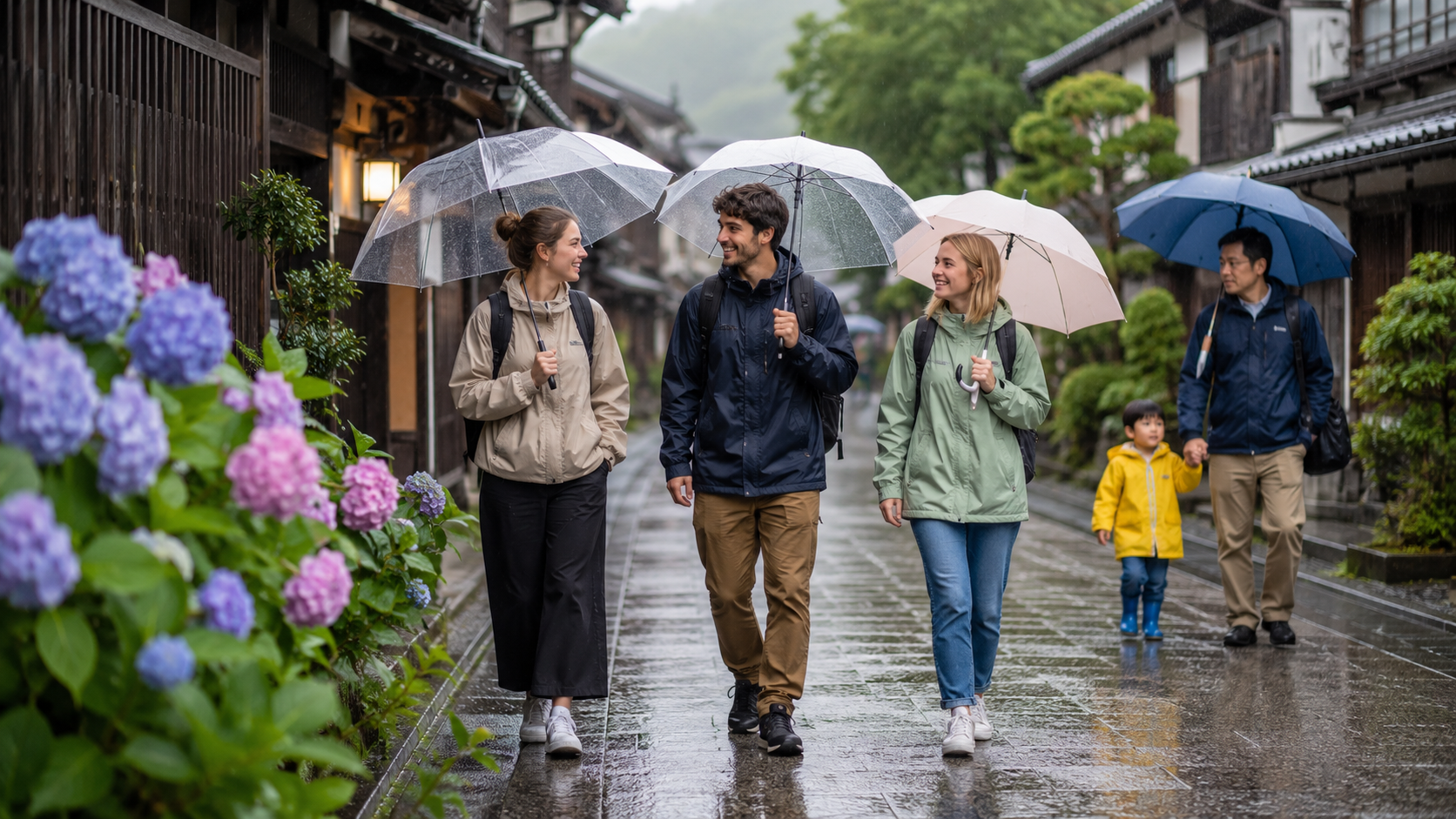
When you walk around Japan during the rainy season, you may see many rainy-day scenes.
At the entrance of some stations or shops, there may be plastic bags for wet umbrellas.
Some shops also have umbrella stands.
On trains, many people try not to touch others with their wet umbrellas.
During busy times, people are careful about how they hold their umbrellas.
You can also find clear plastic umbrellas at many convenience stores.
When it suddenly rains, many people buy umbrellas there.
Japanese convenience stores are very useful.
But if you buy many umbrellas during your trip, they can become extra luggage.
So I think it is helpful to carry a small folding umbrella.
Good Things About Japan’s Rainy Season
The rainy season can be difficult, but it is not only bad.
Rainy days in Japan can have a quiet and calm feeling.
Temples, shrines, and old streets can look beautiful in the rain.
Wet stone paths and green trees can show another side of Japan.
Also, during the rainy season, hydrangeas often bloom beautifully.
Hydrangeas are flowers that can be blue, purple, pink, or other colors.
In Japan, many people think they match the rainy season very well.
However, rainy season travel can be affected by the weather.
So it is helpful to plan not only outdoor places, but also indoor places.
For example:
- museums
- art museums
- shopping malls
- aquariums
- cafes
- station buildings
- indoor restaurants
If you have indoor plans, it is easier to enjoy Japan even on rainy days.
Useful Things to Bring During the Rainy Season
If you visit Japan during the rainy season, these items can be helpful.
A Folding Umbrella
A folding umbrella is useful when rain starts suddenly.
You can buy umbrellas in Japan, but it is more convenient to carry one with you.
Clothes That Dry Easily
Because the air is humid, thick clothes may not dry quickly.
If you plan to do laundry during your trip, quick-drying clothes can help a lot.
Comfortable Shoes
On rainy days, roads and station floors can be slippery.
If you walk a lot while sightseeing, comfortable shoes are important.
It is also good to choose shoes that are not a big problem if they get a little wet.
A Small Towel
A small towel is useful when your bag or clothes get wet.
Japan’s early summer can also be humid, so you can use it to wipe sweat too.
Medicine for Your Health
If you often get headaches, it may be good to bring medicine that you usually use.
Of course, please use medicine that is safe and right for you.
A Flexible Travel Plan Is Better
During the rainy season, it may be better not to make your schedule too tight.
If the rain is strong, walking outside for a long time can be tiring.
When your shoes and clothes get wet, you may feel more tired than expected.
Traveling with children on rainy days can be especially hard.
As a dad, going out with kids on a rainy day takes a little extra energy.
I have to think about umbrellas, towels, extra clothes, and many other things.
If you visit Japan during the rainy season, it may be good to think:
“If everything goes as planned, that is lucky.”
This kind of relaxed feeling can make your trip easier.
Small Rainy-Day Manners in Japan
On rainy days in Japan, there are small manners about umbrellas.
For example, when entering a shop, many people try not to touch products or other people with their wet umbrella.
If there are umbrella bags at the entrance, you can put your wet umbrella in one.
If there is an umbrella stand, you can use it.
On trains and buses, it is nice to hold your wet umbrella downward so it does not touch other people.
But you do not need to worry too much.
Just look at what people around you are doing and be careful in a simple way.
That is usually enough.
Summary: The Rainy Season Is a Little Hard, But It Is Also Part of Japan
The Japanese rainy season may be a little difficult for travelers.
There is a lot of rain.
The air is humid.
Clothes and shoes may not dry easily.
If your body is affected by the weather, some days may feel harder.
For me too, bad weather can cause migraines, so the rainy season sometimes feels depressing.
But with a little preparation, it becomes easier to enjoy.
Bring a folding umbrella.
Choose clothes that dry easily.
Plan some indoor activities.
Do not push yourself too hard.
Rainy Japan has a different feeling from sunny Japan.
Hydrangeas, wet streets, and quiet rainy views are all part of the season.
Even if the weather is not perfect, you may still enjoy the special feeling of this season.
And maybe, your trip to Japan will become even more memorable.
Thank you for reading.
Comments