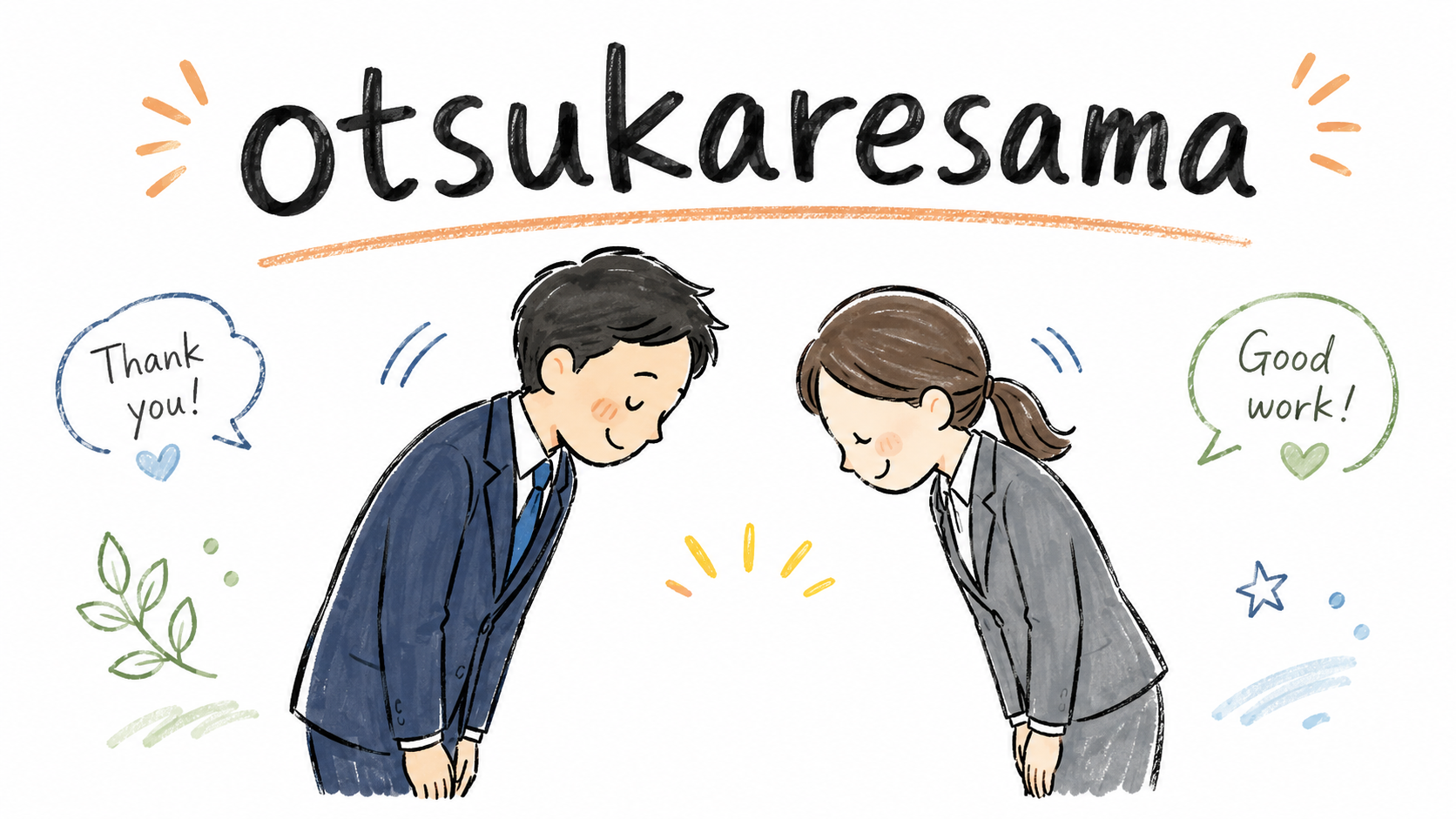
When you live in Japan, you may hear the word “otsukaresama” many times.
At work, someone may say it when they leave the office.
In an email, someone may write it at the beginning.
At home, a parent may say it to a child after swimming class or after helping with housework.
It is a very common Japanese phrase.
But it is also a little difficult to translate into English.
Google Translate may say:
“Thank you for your hard work.”
This is not wrong.
But I think the feeling is closer to:
“You must be tired.”
or
“I know you did your best.”
In Japan, “otsukaresama” is not only a phrase.
It is also a small way to show care.
When Japanese People Say “Otsukaresama”
The most common place I use “otsukaresama” is at work.
When the workday is over and someone is going home, we often say:
“Otsukaresama desu.”
It feels like a goodbye, but it is warmer than just “bye.”
It means something like:
“You worked today.”
“You must be tired.”
“Take care.”
“See you tomorrow.”
Of course, we do not think deeply every time we say it.
Sometimes it is just a normal greeting.
But behind the phrase, there is a small feeling of understanding.
At work, people may be tired.
But it is not always easy to say, “I’m so tired!” again and again.
If you say it too much, other people may worry about you.
They may also feel they need to be careful around you.
So instead, someone says:
“Otsukaresama.”
It is like saying:
“I know. You are tired. You did your best today.”
That small sentence can make people feel a little better.
It Is Also Used in Emails
One interesting thing is that Japanese people may also use “otsukaresama desu” at the beginning of a work email.
For example:
Otsukaresama desu.
This is Hirossy.
To foreign readers, this may feel strange.
Why do Japanese people say “thank you for your hard work” before writing the main message?
But in Japan, it often feels like a polite greeting.
It is similar to starting an email with:
“Hello,”
or
“I hope you are doing well.”
It does not always mean, “You worked very hard today.”
Sometimes it is just a soft way to begin a message.
This is one reason why “otsukaresama” is hard to translate.
The meaning changes depending on the situation.
I Also Say It to My Children
“Otsukaresama” is not only for work.
I also use it with my children.
For example, when my child finishes helping at home, I may say:
“Otsukaresama.”
When my child comes back from a lesson or activity, I may also say it.
It means:
“You did a good job.”
“You must be tired.”
“I saw your effort.”
Children may not think about the deep meaning of the phrase.
But I think they can feel the warmth.
It is not a big compliment like, “You are amazing!”
It is more gentle.
It is a small word that says:
“I noticed what you did.”
As a parent, I think this is important.
Children do many small things every day.
They go to school.
They practice sports.
They help at home.
Sometimes they try hard even when they are tired.
So I like using this phrase.
“Otsukaresama” Is Not Just “Good Job”
Some people translate “otsukaresama” as “Good job.”
This can be correct in some situations.
For example, after a child finishes helping with something, “Good job” is close.
But in many cases, “otsukaresama” has a softer feeling.
It is not only about the result.
Even if the result was not perfect, you can still say “otsukaresama.”
For example, if someone worked hard all day but the work did not go well, you can still say it.
The meaning is not:
“You succeeded.”
The meaning is more like:
“I know you used your energy.”
“I know you tried.”
“You must be tired.”
I think this is a very Japanese part of the phrase.
It cares about the effort, not only the result.
A Phrase for Hidden Tiredness
In Japan, people sometimes do not say their true feelings directly.
For example, at work, someone may be very tired.
But they may not say:
“I am exhausted!”
“I cannot do this anymore!”
“I want to go home!”
Of course, people sometimes say these things with close friends.
But in many public or work situations, they may keep those feelings inside.
So “otsukaresama” helps.
It gives people a small place to put their tired feelings.
When someone says “otsukaresama,” you do not need to explain everything.
You do not need to say, “Yes, I am really tired.”
You can just answer:
“Otsukaresama desu.”
And somehow, both people understand.
I think this is one reason the phrase is used so much in Japan.
Be Careful: It Can Sound Mean in Some Situations
Usually, “otsukaresama” is a kind phrase.
But like many words, the meaning can change depending on the timing and tone.
For example, imagine someone worked very hard on something, but in the end, it became useless.
If another person says “otsukaresama” in a cold or teasing way, it may sound mean.
It may feel like:
“Well, that was a waste of time.”
or
“You worked hard for nothing.”
So timing is important.
If you say it kindly, it sounds warm.
If you say it with a bad tone, it can sound sarcastic.
This is not the most common use, but it is good to know.
Japanese phrases often depend on the feeling behind the words.
How Can Foreign Visitors Use It?
If you visit Japan, you do not need to use “otsukaresama” perfectly.
But if you understand it, you may notice many interesting moments.
You may hear office workers say it when they leave.
You may hear teachers or parents say it to children after an event.
You may see it in messages between coworkers.
If you work with Japanese people, using “otsukaresama desu” can sound polite and natural.
But for travelers, you do not need to use it everywhere.
For example, you do not usually say “otsukaresama” to a store staff member after buying something.
In that situation, “arigatou gozaimasu” is better.
“Otsukaresama” is usually used between people who share some kind of work, activity, or relationship.
Coworkers.
Classmates.
Family members.
Teammates.
People who did something together.
My Simple Translation
If I explain “otsukaresama” to a foreign friend, I would say this:
“Otsukaresama means, ‘You must be tired, and I know you did your best.’”
It is not a perfect translation.
But I think it shows the heart of the phrase.
It is a word for work.
It is a word for effort.
It is a word for tiredness.
And it is also a word for kindness.
In Japan, many people use it every day without thinking too much.
But when I stop and think about it, I feel it is a very interesting phrase.
It shows how Japanese people often care for each other quietly.
Not with big words.
Not with a long speech.
Just one small phrase:
Otsukaresama.
Final Thoughts
“Otsukaresama” is one of those Japanese words that is hard to translate.
It can mean “thank you for your hard work.”
It can mean “good job.”
It can mean “you must be tired.”
It can also be a simple greeting at work.
But for me, the most important feeling is this:
“I noticed your effort.”
When I say it to a coworker at the end of the day, it feels like a small goodbye with care.
When I say it to my child after helping at home or finishing a lesson, it feels like a small hug in words.
Maybe that is why Japanese people use “otsukaresama” so often.
It is short.
It is simple.
But it can carry a lot of kindness.
Comments