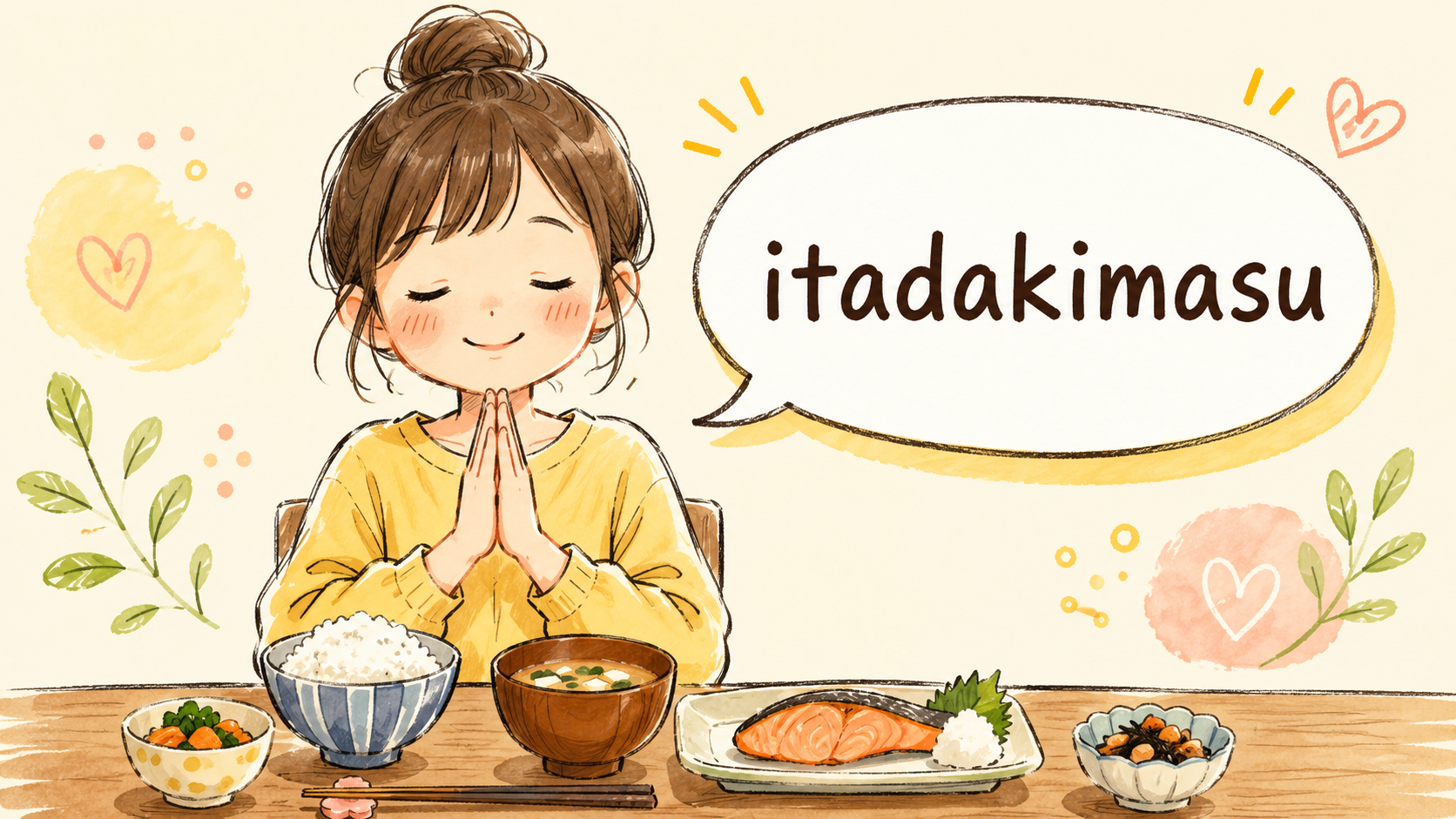
When you watch Japanese anime, movies, or videos, you may hear people say “itadakimasu” before eating.
Maybe you wonder:
“Does it mean thank you?”
“Is it like a prayer?”
“Do Japanese people really say it every day?”
Hello, I’m Hirossy.
I’m an ordinary Japanese dad, and in my home, we usually say “itadakimasu” before we start eating.
It is a very common word in Japan, but the meaning is a little deeper than just “Let’s eat.”
In this article, I will explain the meaning of itadakimasu in a simple and friendly way.
The Simple Meaning of Itadakimasu
Itadakimasu is a Japanese phrase that people often say before eating.
In simple English, it can mean:
“I humbly receive this food.”
But in daily life, many Japanese people use it with a feeling like:
“Thank you for the food.”
“Thank you to the person who made this meal.”
“Thank you for the life and ingredients we are receiving.”
So, itadakimasu does not have only one meaning.
It can include thanks to the food, the cook, the farmers, the people who prepared the meal, and the life of the ingredients.
Of course, not every Japanese person thinks deeply about all of this every time. For many people, it is also a normal habit before eating.
But behind the word, there is a warm feeling of gratitude.
Is Itadakimasu a Religious Word?
Some people may think itadakimasu is like a prayer before meals.
It can feel similar in some ways, because people say it before eating and it shows thanks.
But in daily life in Japan, itadakimasu is usually not a strongly religious word.
Many families say it as a normal part of eating. Children say it at home, at school lunch, and sometimes at restaurants too.
Japan has many cultural habits connected to gratitude, manners, and respect. Itadakimasu is one of them.
So, you do not need to think of it as a strict religious rule. It is more like a gentle custom before starting a meal.
Why Do Japanese People Say Itadakimasu?
There are a few ideas behind this word.
1. Gratitude for the Food
First, itadakimasu shows thanks for the food itself.
Food does not appear on the table by magic. Someone grew the rice or vegetables. Someone caught or prepared the fish or meat. Someone cooked the meal.
Even a simple meal has many people and many steps behind it.
Saying itadakimasu is a small way to remember that.
2. Gratitude for the Person Who Made the Meal
At home, it can also mean thanks to the person who cooked.
For example, when my family eats at home, we say itadakimasu before starting.
As a dad, I also try to remind my children.
Sometimes I say:
“Did you say itadakimasu properly before eating?”
I do not say this because I want to be strict. I say it because I want them to grow up with a natural feeling of thanks.
In Japan, many parents teach this phrase to their children from a young age. It becomes part of everyday family life.
3. Gratitude for Life
This part may be a little deep, but it is important.
In Japanese culture, itadakimasu can also include the idea that we receive life from plants and animals.
For example, meat, fish, vegetables, and rice all come from living things.
So the phrase can carry a feeling like:
“Thank you for the life that becomes my food.”
Not everyone says it with this exact thought every day, but this idea is part of the background of the word.
When Do Japanese People Say Itadakimasu?
Many Japanese people say itadakimasu before eating.
You may hear it in places like these:
- At home before dinner
- At school lunch
- Before eating a bento
- At a restaurant with family or friends
- In anime, dramas, or Japanese videos
In my home, we usually say it before meals at home.
When children are very hungry, they may start eating quickly. So as a parent, I sometimes remind them to say itadakimasu first.
This is a very normal family scene in Japan.
Of course, every family is different. Some families say it clearly every time. Some people say it quietly. Some adults may not say it much when they eat alone.
So if you visit Japan, you do not need to worry too much. It is not about being perfect. It is about understanding the feeling.
How Do You Say Itadakimasu?
The pronunciation is:
ee-tah-dah-kee-mahss
You can say it before eating.
Many people lightly put their hands together when they say it. This is common, but it is not always necessary.
For example, at home or school, people may put their hands together and say:
Itadakimasu.
At a restaurant, some people say it quietly. Some people may not say it out loud, especially if they are eating alone.
If you are with Japanese friends or a host family, saying itadakimasu before eating can feel polite and friendly.
You do not need perfect pronunciation. If you say it with a kind feeling, that is enough.
What About Gochisousama?
After eating, Japanese people often say:
Gochisousama
or more politely:
Gochisousama deshita
This means something like:
“Thank you for the meal.”
If itadakimasu is said before eating, gochisousama is said after eating.
For example, at home, children may say gochisousama after finishing dinner.
At a restaurant, some people say gochisousama deshita to the staff when leaving. It is a simple way to show thanks.
So these two phrases are often used as a pair:
Before eating: Itadakimasu
After eating: Gochisousama
Both phrases are connected to gratitude.
Advice for Foreign Visitors
If you come to Japan, you may hear itadakimasu many times.
You do not have to feel nervous about using it.
If you are eating with Japanese people, you can simply say itadakimasu before the meal. Many Japanese people will probably feel happy that you know this word.
But please remember, Japan does not have only one style.
Some people say it loudly. Some people say it quietly. Some people do not say it every time.
So the important thing is not to follow the custom perfectly. The important thing is to understand the feeling behind it.
It is a small word, but it can show respect for food and the people around you.
Conclusion
Itadakimasu is a simple Japanese phrase, but it has a warm meaning.
It can mean thank you for the food, thank you to the person who made the meal, and thank you for the life we receive.
In my home, I try to remind my children to say itadakimasu before eating. Not because it is a strict rule, but because I want them to keep a small feeling of gratitude in daily life.
If you visit Japan or learn Japanese culture, itadakimasu is a beautiful word to know.
You do not need to understand every deep meaning at first.
Just knowing that it is a word of thanks can make Japanese meals feel a little more familiar.
And maybe, the next time you eat Japanese food, you can try saying:
Itadakimasu.
Comments