Hello, I’m Hirossy.
When people from other countries visit Japan, they may notice something strange.
“Japan is so clean, but why are there so few trash cans?”
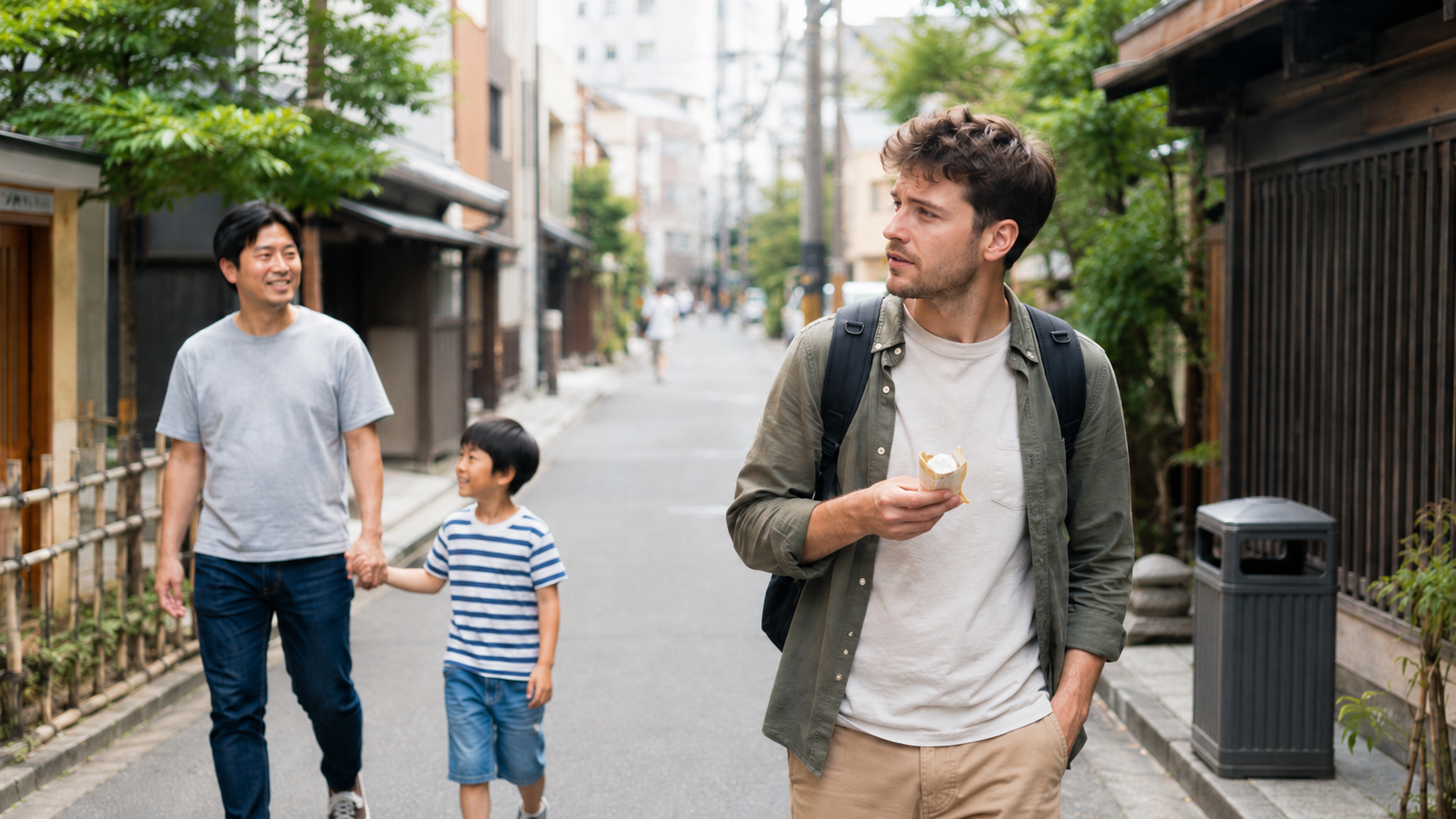
You may walk around a station, a street, or a park and want to throw away an empty plastic bottle or a snack wrapper.
But sometimes, you cannot find a trash can easily.
For travelers, this can be a little confusing.
As an ordinary Japanese dad, I sometimes go out with my children by car. We also go to festivals from time to time.
At those times, I have thought,
“Where can I throw this trash away?”
In this article, I will gently explain why there are so few trash cans in Japan.
- The Short Answer: Many People in Japan Take Their Trash Home
- Why Are There So Few Trash Cans in Japan?
- I Had Trouble Finding a Trash Can at a Festival
- When We Go Out by Car, We Often Take Trash Home
- Japanese Streets Are Clean, But Not Because There Are Many Trash Cans
- Friendly Advice for Travelers in Japan
- Having Few Trash Cans Can Be Inconvenient
- Conclusion: A Small Bag Can Help You Enjoy Japan More
The Short Answer: Many People in Japan Take Their Trash Home
There is not only one reason why Japan has few trash cans.
But one big reason is this idea:
“Your trash is your responsibility.”
In Japan, many people take their own trash home or throw it away at the place where they bought something.
Of course, not all Japanese people do this perfectly.
Sometimes you can see trash on the street. Sometimes trash cans are full.
But in general, many people in Japan try not to leave their trash outside.
So there are not trash cans everywhere in the city.
For people from other countries, this may feel a little inconvenient.
But it is connected to Japanese daily habits, garbage separation rules, and how public spaces are managed.
Why Are There So Few Trash Cans in Japan?
Trash cans can become too full
This may sound a little strange, but when a trash can is placed outside, many people may throw trash into it.
Sometimes people throw away not only small trash, but also household trash or large trash.
Then the trash can becomes too full.
When trash overflows, it does not look nice.
It can also cause bad smells or attract crows.
So in Japan, people do not always think,
“If we place more trash cans, the city will become cleaner.”
It is not that simple.
Trash cans need people to collect the trash, separate it, and keep the area clean.
Because of this, some places choose to have fewer trash cans.
Japan has detailed garbage separation rules
In Japan, garbage separation rules can be quite detailed.
For example, trash may be separated into:
- Burnable garbage
- Non-burnable garbage
- Plastic bottles
- Cans
- Glass bottles
- Plastic
The rules are different depending on the city or town.
Even in Japan, the way to throw away trash can change when you move to another area.
If trash cans are placed in public areas, they often need different bins for different types of trash.
But travelers and busy people may not always know how to separate trash correctly.
So managing public trash cans can become difficult.
Places that sell food and drinks often have trash cans
Japan does not have zero trash cans.
For example, you may find trash cans at convenience stores, supermarkets, food courts, station shops, and near some vending machines.
Places that sell food and drinks often have trash cans for the trash that comes from those products.
But these trash cans are usually for things bought at that place.
For example, a convenience store trash can is mainly for trash from that convenience store.
It may not be good manners to bring a lot of trash from home or from another place and throw it away there.
This point may be a little hard to understand for travelers.
In Japan, even if there is a trash can, it may not mean,
“You can throw away any trash here.”
It is closer to,
“This is for trash from this place.”
I Had Trouble Finding a Trash Can at a Festival
One time I had trouble finding a trash can at a Japanese festival.
At Japanese festivals, you can buy many kinds of food from food stalls.
For example, yakisoba, takoyaki, fried chicken, and shaved ice.
Both children and adults can enjoy them.
But after eating, you may think,
“Where should I throw away this food container?”
At some festivals, there are trash cans or trash collection areas.
But at other places, they are hard to find.
I have bought food from a festival stall and then could not find a trash can.
When I am with my children, I already have bags and other things to carry.
So walking around with an empty food container is a little difficult.
But of course, we cannot just leave it on the street.
In the end, we may carry the trash for a while or take it back to the car.
At times like this, I really feel,
“Japan is clean, but trash cans are really hard to find.”
When We Go Out by Car, We Often Take Trash Home
In my family, we sometimes go out by car with our children.
When we go out, we may stop at a convenience store and buy drinks or snacks.
When you have children, small trash appears very quickly.
Plastic bottles, snack wrappers, tissues, and so on.
But parks, parking lots, or other places do not always have trash cans.
So we sometimes keep the trash in the car for a while and throw it away after we get home.
It is a little inconvenient, but in Japan, this feeling is quite normal.
Especially when you go out with children, it is useful to bring a small bag for trash.
For travelers too, keeping a small plastic bag or paper bag in your bag can be very helpful.
Japanese Streets Are Clean, But Not Because There Are Many Trash Cans
Some people from other countries may think,
“Japanese streets are clean, so there must be many trash cans.”
But actually, it can feel like the opposite.
Japanese streets are not clean only because there are many trash cans.
In many cases, they are clean because people take their trash home or throw it away in the correct place.
Of course, I do not want to say Japan is perfect.
Even in Japan, you may see trash at tourist spots or event areas.
Some people do not follow good manners.
But overall, I think many people in Japan have the idea of not leaving their trash outside.
Friendly Advice for Travelers in Japan
When you travel in Japan, you may not find a trash can right away.
This can happen especially when you carry snacks or plastic bottle drinks.
So it is a good idea to bring a small bag with you.
You can put your empty bottle, snack wrapper, or small trash in it for a while.
Then you can throw it away later at your hotel, a convenience store, a station, or another proper place.
If you buy food or drinks at a convenience store, that store may have a trash can.
But these days, some stores put trash cans inside the store.
Some stores hide them in a less visible place.
And some stores do not have trash cans at all.
So it is easier to think,
“I may need to carry this trash for a while.”
That way, you will not feel too stressed.
Having Few Trash Cans Can Be Inconvenient
There are reasons why Japan has few trash cans.
But honestly, it can be inconvenient.
When you eat while traveling, go out with children, or buy food at a festival, a trash can would be very helpful.
Even I, as a Japanese person, sometimes feel this way.
So it is very natural if visitors from other countries feel confused.
If you think,
“Why is this so inconvenient?”
that feeling is not strange at all.
It is just one of the differences in culture and daily life.
Conclusion: A Small Bag Can Help You Enjoy Japan More
In many places in Japan, there are not many public trash cans.
There are several reasons for this.
Trash cans can overflow, garbage separation rules are detailed, public trash cans need careful management, and many people have the habit of taking their trash home.
But places that sell food and drinks often have trash cans.
When you travel in Japan, it is helpful to carry a small bag for your trash.
Having few trash cans may feel inconvenient at first.
But when you know the reason behind it, you can understand a little more about Japanese daily life and public manners.
If you cannot find a trash can in Japan, please do not worry too much.
With a little preparation, you can enjoy walking around Japan more comfortably.
This was Hirossy.
Comments