When people from other countries hear about Japanese New Year, they may have some questions.
“How do Japanese people celebrate New Year?”
“Is it like a Christmas party?”
“Why do many people visit shrines?”
Hello, I’m Hirossy.
As an ordinary Japanese dad, I feel that Japanese New Year is not only a big event. It is also a warm family time.
In Japan, New Year is called Oshogatsu.
Of course, every family is different.
But many families clean the house at the end of the year, watch TV on New Year’s Eve, eat special food, and visit a shrine after the new year begins.
In this article, I will gently introduce how many Japanese families celebrate Oshogatsu.
Japanese New Year Is a Time for Family
In Japan, many people think the first few days of January are very important.
Schools and many companies are closed.
Families spend time together.
Some people visit their relatives and say New Year greetings.
In some countries, New Year may feel like a big party with fireworks and countdown events.
Japan also has countdown events, especially in big cities.
But many Japanese people spend New Year quietly at home with family.
In my family, we sometimes watch Kohaku Uta Gassen on New Year’s Eve.
Kohaku Uta Gassen is a famous Japanese music TV show.
When I watch it with my family, I feel,
“Ah, this year is almost over.”
It is not a very flashy moment.
But for me, it feels very Japanese and very peaceful.
Cleaning the House Before New Year
At the end of the year, many Japanese families do osoji.
Osoji means a big cleaning.
It is more than normal cleaning.
People may clean the windows, throw away old things, and clean places they usually do not clean.
This is one way to prepare for the new year.
The idea is to welcome the new year with a clean home and a fresh feeling.
When I clean the house at the end of the year, I always feel,
“This year is really ending.”
In busy daily life, we do not always have time to think about the year.
But while cleaning, I often remember many things that happened during the year.
For people from other countries, it may feel a little strange.
“Why do Japanese people clean before New Year?”
But in Japan, osoji is a natural part of preparing for Oshogatsu.
New Year’s Eve and Kohaku Uta Gassen
December 31 is called Omisoka in Japan.
It means New Year’s Eve.
Many people spend Omisoka at home.
They eat dinner, relax, watch TV, and wait for the new year.
One famous TV show is Kohaku Uta Gassen.
Many famous singers appear on this show every year.
For many Japanese people, it is one of the most famous year-end TV programs.
Of course, these days, some families watch YouTube, Netflix, or other programs.
Every family has its own style.
But for many people, Kohaku Uta Gassen still gives a strong feeling of the end of the year.
For me, watching TV with my family on New Year’s Eve is a quiet but warm Japanese tradition.
Eating Ozoni on New Year
Japanese New Year has many special foods.
One famous food is osechi ryori.
Osechi is special New Year food.
It is often put in beautiful boxes.
But not every family eats osechi in the same way.
Some families eat a lot of it.
Some families eat only a little.
Some families do not eat it much.
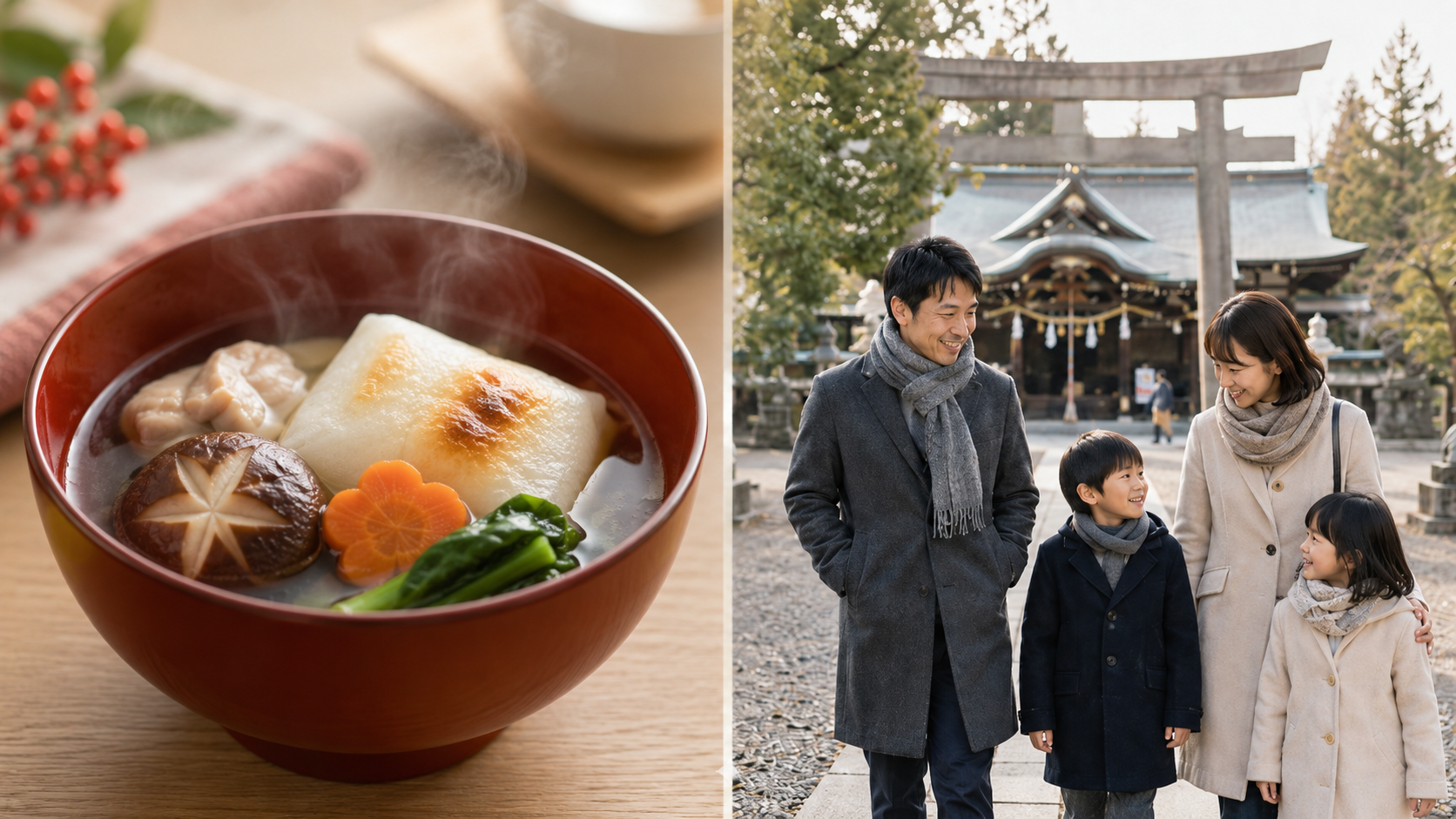
Another important New Year food is ozoni.
Ozoni is a soup with mochi, or rice cake.
The taste and ingredients are different depending on the region and family.
Some ozoni has soy sauce soup.
Some has miso soup.
Some has chicken, vegetables, or other ingredients.
For me, ozoni with mochi is very delicious.
It is one of my favorite New Year foods.
In the cold season, warm ozoni makes me feel relaxed and happy.
If I explain it simply, ozoni is like Japanese rice cake soup.
But mochi is very sticky, so please eat it slowly and carefully.
Visiting a Shrine for Hatsumode
After the new year begins, many people go to hatsumode.
Hatsumode means the first visit to a shrine or temple in the new year.
People pray for health, happiness, and a good year.
Some people buy lucky charms.
Some people draw omikuji, which is a paper fortune.
But hatsumode is not something everyone must do.
Some people go on January 1.
Some people go a few days later to avoid crowds.
Some people do not go.
In my family, we go to a shrine for hatsumode.
Near the shrine, we sometimes buy ningyo-yaki.
Ningyo-yaki is a small sweet cake.
It often has sweet red bean paste inside.
At some shrines, there are food stalls during New Year.
For children, this is also a fun part of hatsumode.
Adults may think about the new year and pray quietly.
Children may enjoy the food stalls and sweets.
I think this balance is very nice.
It feels like a real family New Year in Japan.
Otoshidama: A Happy New Year Gift for Children
For children in Japan, one of the most exciting parts of New Year is otoshidama.
Otoshidama is money that adults give to children during New Year.
It is usually put in a small envelope called a pochi-bukuro.
When I was a child, I looked forward to visiting my relatives’ homes during New Year.
Of course, New Year greetings were important.
But to be honest, I was also very excited to receive otoshidama.
Now I am an adult and a parent.
So I am on the giving side.
When I was a child, otoshidama made me very happy.
But as a parent, I understand that it can also be a little hard for adults.
Still, when I see children’s happy faces, I remember my own childhood.
Visiting Relatives During New Year
In Japan, some families visit relatives during New Year.
People say,
“Akemashite omedetou gozaimasu.”
This means “Happy New Year.”
Relatives may eat together, talk, and spend time together.
For children, it may also be a chance to receive otoshidama.
But Japanese New Year is changing too.
Some families live far away from relatives.
Some families prefer to relax at home.
Some people travel during New Year.
So not all Japanese families celebrate in the same way.
Some families keep old traditions.
Some families enjoy a more simple and modern New Year.
Both are normal.
Tips for Visitors During Japanese New Year
If you visit Japan during New Year, there are a few things to know.
First, some shops and restaurants may be closed.
These days, many convenience stores and large stores are open.
But small shops and restaurants may close for a few days.
So it is a good idea to check opening hours before you go.
Second, famous shrines and temples can be very crowded during hatsumode.
If you do not like crowds, you may want to visit a few days after January 1.
Third, many people visit shrines quietly.
Taking photos may be okay in some places, but please be careful not to disturb other people.
Also, if there are food stalls near a shrine, you can enjoy Japanese festival-style food.
You may find ningyo-yaki, takoyaki, yakisoba, amazake, and other foods.
If you look not only at the shrine, but also at the families around you, you may feel the warm atmosphere of Japanese New Year.
Summary
Japanese New Year is not only a day to celebrate the new year.
People clean their homes at the end of the year.
Families watch TV together on New Year’s Eve.
Many people eat ozoni.
Some people visit a shrine for hatsumode.
Children look forward to otoshidama.
These small traditions make the atmosphere of Oshogatsu.
Of course, every family and region is different.
There is no single “perfect” way to celebrate Japanese New Year.
But for many people, Oshogatsu is a time to feel family, tradition, and a fresh start.
It may not always be a big party.
But it is quiet, warm, and special.
As an ordinary Japanese dad, this is how I feel about Japanese New Year.
I hope this article helps you feel a little closer to Japan and Oshogatsu.
Comments