Hello, I’m Hirossy.
I am a Japanese father raising three children. My oldest daughter is 10, my younger daughter is 8, and my son is 6. All three are in elementary school.
When people imagine traveling in Japan with children, they may picture clean trains, convenient transportation, a generally safe environment, convenience stores, and plenty of family-friendly attractions. That picture is not wrong, but “family-friendly” does not mean “effortless.”
Japan can be a wonderful place for a family trip.
Large stations involve a lot of walking. Trains can become crowded. Summer in Japan can be dangerously hot. Children may become hungry, tired, or excited at exactly the moment when a parent wants everything to go smoothly.
I know that feeling very well.
This guide is mainly based on my experience traveling with elementary-school-age children. Families with babies or toddlers may need additional preparation for strollers, diapers, nursing rooms, and naps.
If I could give families one piece of advice about traveling in Japan with children, it would be this:
Do not plan too much. Choose one main activity, leave time to rest, and value a happy family day more than a perfect itinerary.
- Is Japan Easy to Travel Around with Children?
- My Most Important Advice: Plan Less
- Traveling by Train with Children
- Finding Food for Children in Japan
- Prepare for Japan’s Summer Heat
- Toilets and Restroom Breaks
- What to Pack—and What to Buy in Japan
- A Realistic One-Day Plan for Families
- What to Do When Plans Go Wrong
- Final Thoughts
- Official References
Is Japan Easy to Travel Around with Children?
In many ways, yes.
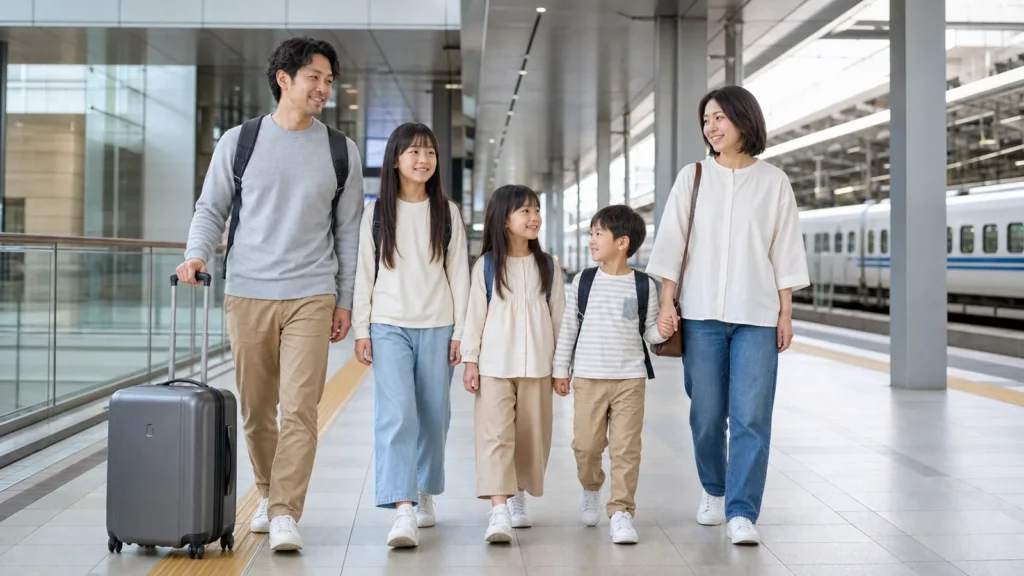
Trains connect most major sightseeing areas. Convenience stores make it easy to buy drinks, snacks, and simple meals. Stations and shopping malls often have toilets. Japan also has many parks, aquariums, museums, zoos, and casual family restaurants, often called famiresu in Japan.
The official Japan National Tourism Organization also provides a guide to traveling in Japan with children, including information about public transportation and family facilities.
Still, every location is different.
An elevator may be far from the platform you need. A famous attraction may be much more crowded than expected. A walk that looks short on a map can feel very long when a child is tired—or when the temperature is close to 40°C.
Japan gives families many useful options, but a little extra time makes those options much easier to use.
My Most Important Advice: Plan Less
Adults may be able to visit several places in one day.
Children experience the same day differently.
They walk through large stations, wait for trains, stand in lines, and try unfamiliar food. Even when they are having fun, all of that uses energy.
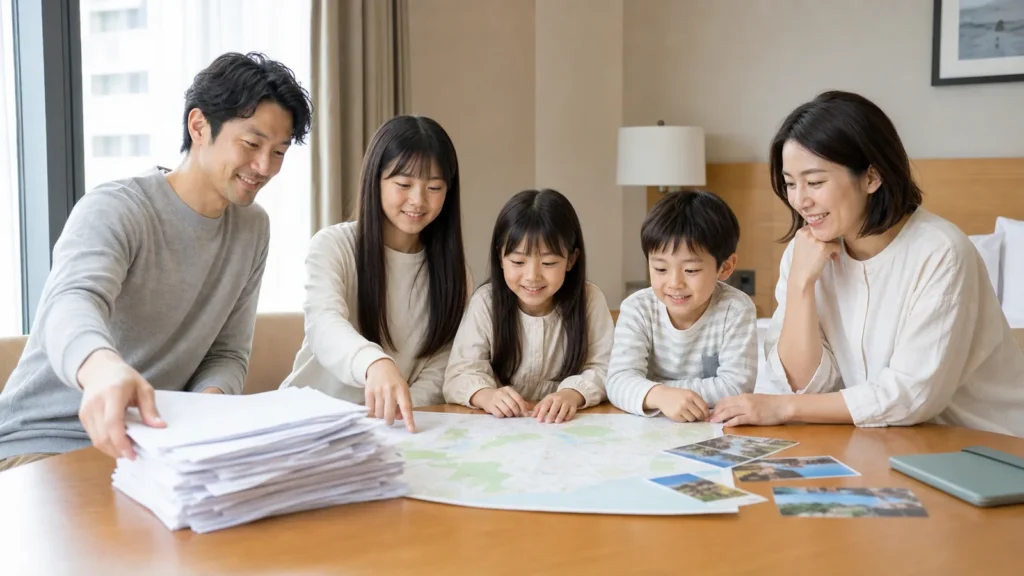
For many families, planning one main activity per day is a good starting point.
That does not mean you must return to the hotel immediately afterward. If everyone still has energy, you can add a short activity in the evening.
The important point is to leave space in the schedule.
As a father, I would rather remove one activity than make everyone exhausted. A child who is tired does not care how famous the next temple or museum is.
To be honest, an exhausted father may not care either.
Traveling by Train with Children
Japan’s train system is convenient, but a train journey with children requires more attention than traveling alone.
Avoid Rush Hour When Possible
Commuter trains can become very crowded in the morning and evening, especially in major cities.
If your schedule is flexible, traveling outside the busiest periods can make the journey more comfortable. You will have more room to stay together, check signs, and get off the train without rushing.
Large stations can also involve long walks between platforms. Allow extra transfer time, even when a route app shows that a quick connection is possible.
For the basic steps, tickets, IC cards, and station manners, see my guide to riding trains in Japan.
Use the Toilet and Buy Drinks Before Boarding
Before a long ride, I recommend asking children whether they need the toilet—even when they say they are fine.
Parents probably understand why.
It is also a good idea to buy drinks before boarding, especially before a long journey. Vending machines and convenience stores are common, but they may not be nearby exactly when you need them.
Children May Become Excited on Trains
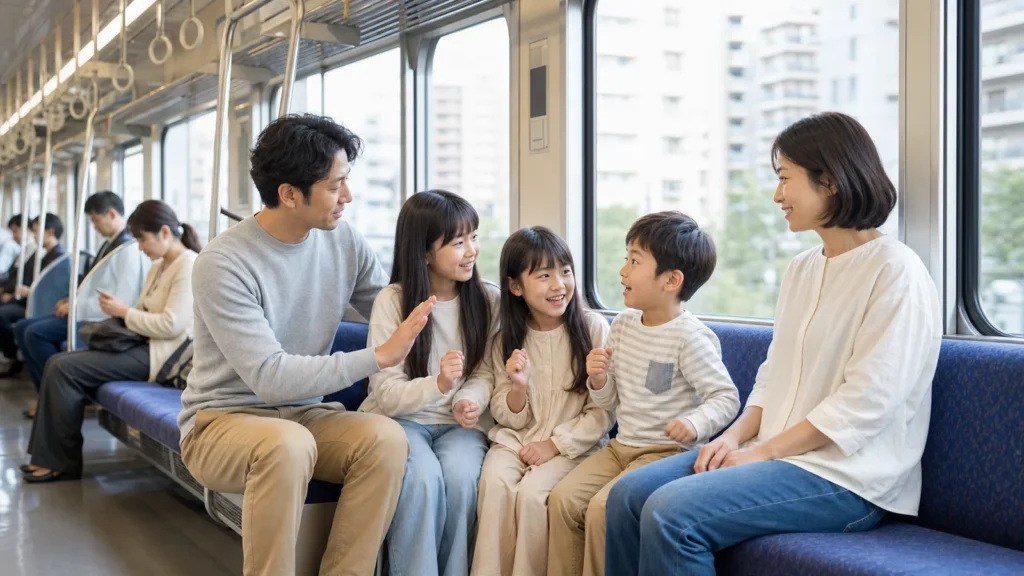
My children sometimes become excited when we ride a train together.
They talk, laugh, and enjoy the experience. Meanwhile, I find myself watching them and wondering:
“Are we disturbing the people around us?”
I do not expect children to behave like silent adults. However, many passengers use train time to rest, read, or look at their phones. If my children become too loud, I remind them to lower their voices and stay near us.
This is not about making children afraid of trains. It is simply about sharing a public space with other passengers.
For a longer journey, a small book, drawing set, quiet game, or downloaded video watched with headphones may help children pass the time. It does not need to be complicated.
Consider Reserved Seats for Long Trips
For Shinkansen journeys, reserved seats can make family travel less stressful. Sitting together is easier when your seats are decided before boarding.
My simple Shinkansen guide explains tickets, platforms, boarding, and luggage in more detail.
Check Child Fares Before Booking
On JR Central services, children ages 6 to 11 generally pay half the adult fare for basic tickets, limited-express tickets, and reserved seats. Some charges, such as Green Car fees, follow different rules. Younger children may also need a child ticket if they use their own reserved seat.
Rules can vary depending on the ticket and railway operator, so check the official information before booking. JR Central explains its classifications on its official Adults and Children page.
An IC card can make local journeys easier, but child cards and visitor products have different conditions. For the basic system, see my beginner-friendly Suica guide.
Finding Food for Children in Japan
One concern for parents is whether their children will find something they want to eat.
Japan offers many interesting foods, but children do not suddenly become adventurous eaters just because they are traveling.
You do not need to force every meal to become a cultural lesson.
Convenience Stores Are Useful for Quick Food
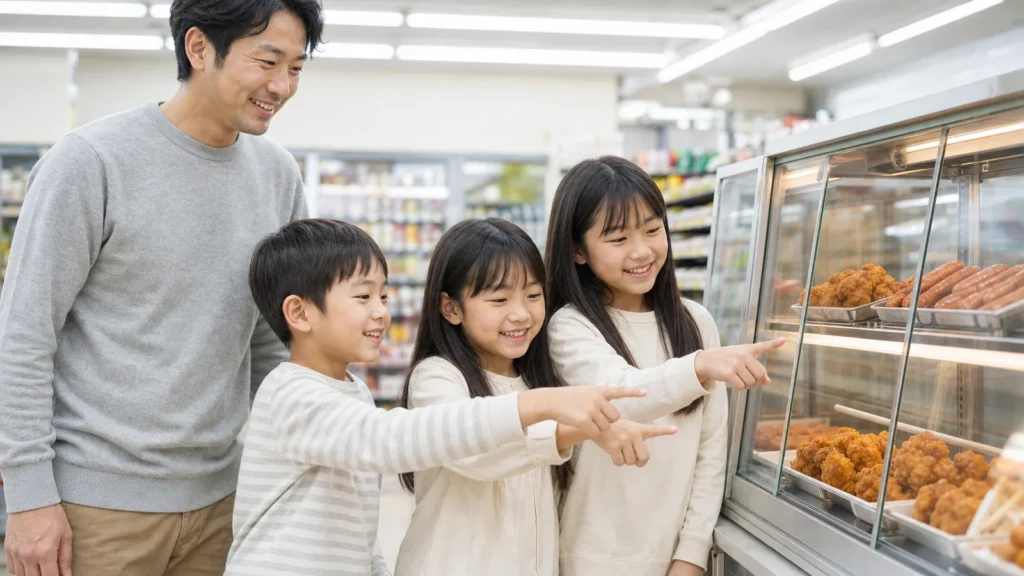
Convenience stores are helpful when children become hungry between meals.
My children often head straight for the hot-snack counter. They especially like fried chicken and frankfurters.
They are not thinking:
“This is an important opportunity to study Japanese food culture.”
They are thinking:
“I want chicken.”
Convenience stores also sell rice balls, bread, sandwiches, bananas, yogurt, drinks, and other simple foods. The selection depends on the store, and availability can change during the day.
For more ideas, see my guide to the best Japanese convenience-store food.
Do Not Assume Every Child Will Like Japanese Food
Trying local food can be one of the best parts of a trip. However, a tired and hungry child may not want to experiment.
Family restaurants, bakeries, supermarkets, and convenience stores give parents more options. Keeping one familiar snack in your day bag can also be useful, especially during long transfers or lines.
If your child has a food allergy or dietary restriction, check ingredient information carefully and prepare a written Japanese explanation that clearly lists the foods they must avoid. Families managing severe allergies should research restaurants and emergency options before traveling.
Prepare for Japan’s Summer Heat
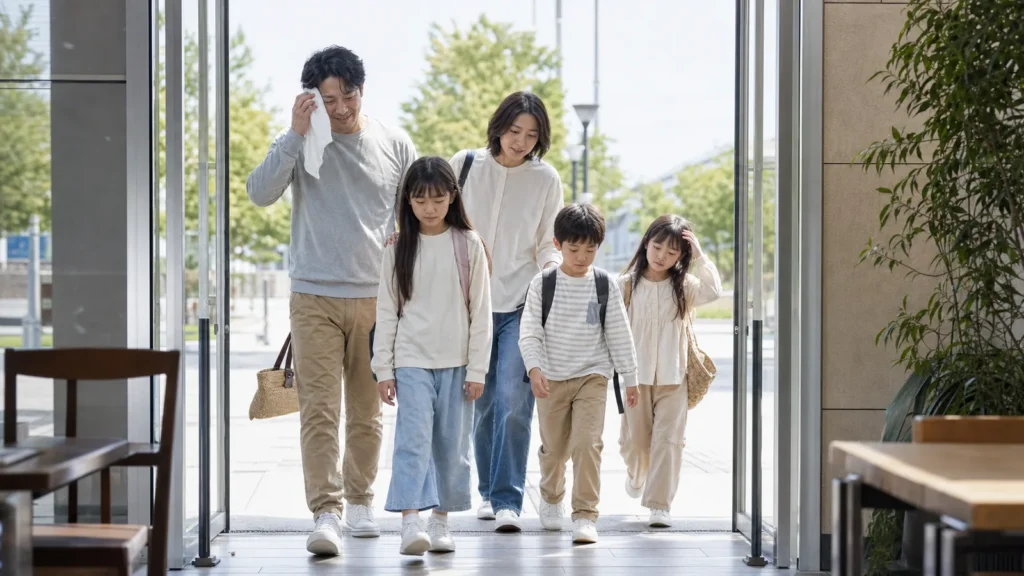
Summer in Japan is not only hot. It is also humid.
Children can become tired faster than adults, and walking between stations and attractions adds up quickly.
I experienced this during a family trip to Kariya Highway Oasis.
The temperature was around 38°C. We wanted to enjoy the outdoor area, but the heat was too intense. In less than an hour, we moved inside to the air-conditioned food court.
That was not a failure in our travel plan.
Going inside was the correct decision.
What We Use in Summer
For summer outings, hats, parasols, drinks, and regular indoor breaks are important for our family.
I recommend:
- checking the weather forecast and heat alerts
- planning outdoor activities for cooler parts of the day when possible
- avoiding long outdoor periods during the hottest time of day
- carrying enough fluids and drinking regularly
- using hats and parasols for shade
- taking frequent breaks in air-conditioned places
- changing the plan immediately if someone feels or looks unwell
A portable fan or cooling towel may make a person feel more comfortable, but it should not replace water, shade, air conditioning, and rest.
Japan’s Ministry of the Environment publishes official heat-stroke prevention information and Heat Stroke Alerts. Check current information during a summer trip.
I also explain the climate in more detail in Japanese Summer Is Hot: What Foreign Visitors Should Know.
Toilets and Restroom Breaks
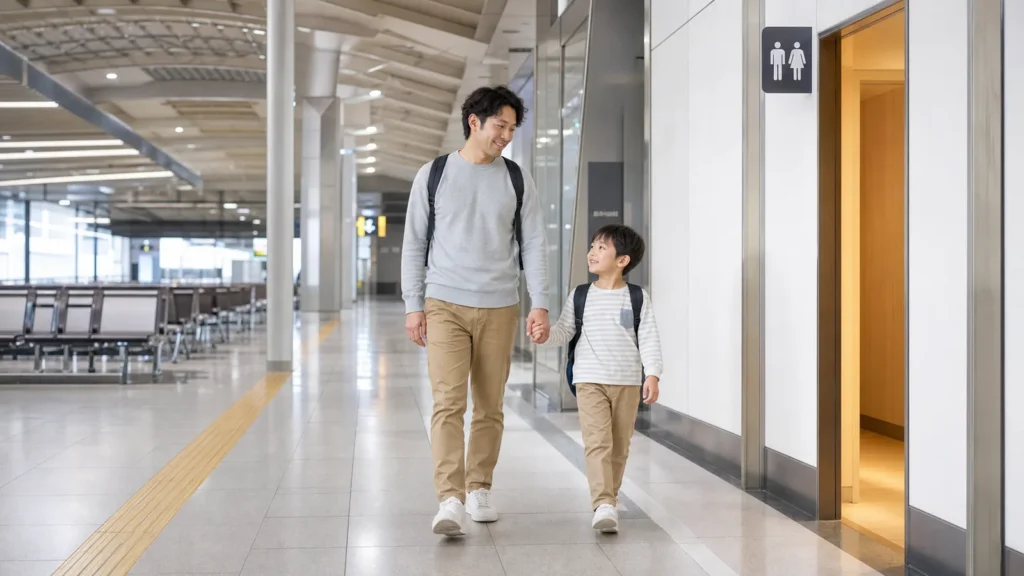
Toilets are available at many stations, shopping malls, department stores, parks, and other public facilities.
However, “there is a toilet in the station” does not always mean it is close to your platform.
Large stations can be surprisingly large. A toilet may be inside or outside the ticket gates, on another floor, or at the opposite end of the building.
Before a long train ride or a long line, ask children whether they need to go. It is easier to spend five minutes on a toilet break than to solve an emergency after the train has departed.
Some convenience stores provide toilets, but not every store does. Look for signs and ask staff when necessary.
Accessible toilets, diaper-changing spaces, and other child facilities vary by location. Families with specific needs should check major stations and attractions in advance.
What to Pack—and What to Buy in Japan
Packing lightly is useful, especially when your family needs to use trains and stairs.
But packing lightly does not mean carrying nothing.
It means carrying what your family needs for that day and buying common items locally when practical.
Useful Items for a Family Day
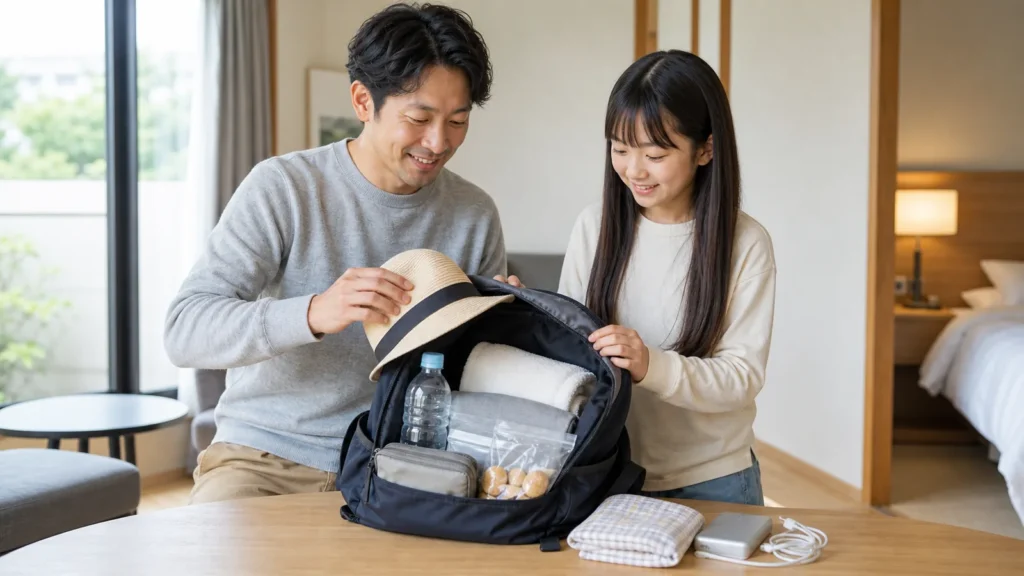
Depending on the season and your children’s needs, your day bag may include:
- a hat or sun hat
- water or another drink
- a small towel
- necessary medicine
- a familiar snack
- a small rubbish bag
- a change of clothes
- a power bank and charging cable
A power bank has helped me during family travel. Phones are used for maps, train routes, translations, reservations, photos, and messages. Battery power disappears faster than expected when you use all of them.
For my complete list—and the items I would actually prioritize—see What to Pack for Japan: 10 Travel Essentials Recommended by a Japanese Dad.
Common Items Can Be Bought in Japan
Drinks, ordinary snacks, tissues, wet wipes, and some toiletries are easy to find in many convenience stores, drugstores, supermarkets, and 100-yen discount stores.
This means you do not need to carry a full supply for your entire trip every morning.
However, bring important medicine and any product your child must use. Do not assume a specific brand or special item will be available near your hotel.
A Realistic One-Day Plan for Families
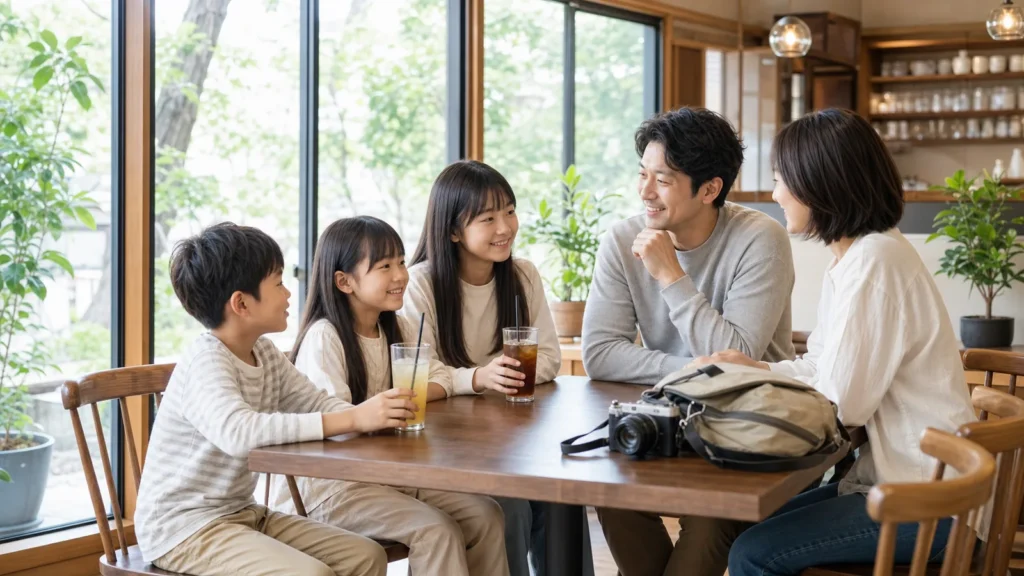
There is no perfect schedule for every family, but a realistic day might look like this:
Morning: Visit one main attraction while everyone has energy.
Lunch: Eat before children become extremely hungry or tired.
Afternoon: Rest at the hotel, a café, a shopping mall, or an indoor attraction.
Evening: Add a short activity only if everyone still has energy.
This is not a rule. Some children can enjoy a long day, while others need more breaks.
But this schedule is often more realistic than planning four or five major attractions and rushing between them.
What to Do When Plans Go Wrong
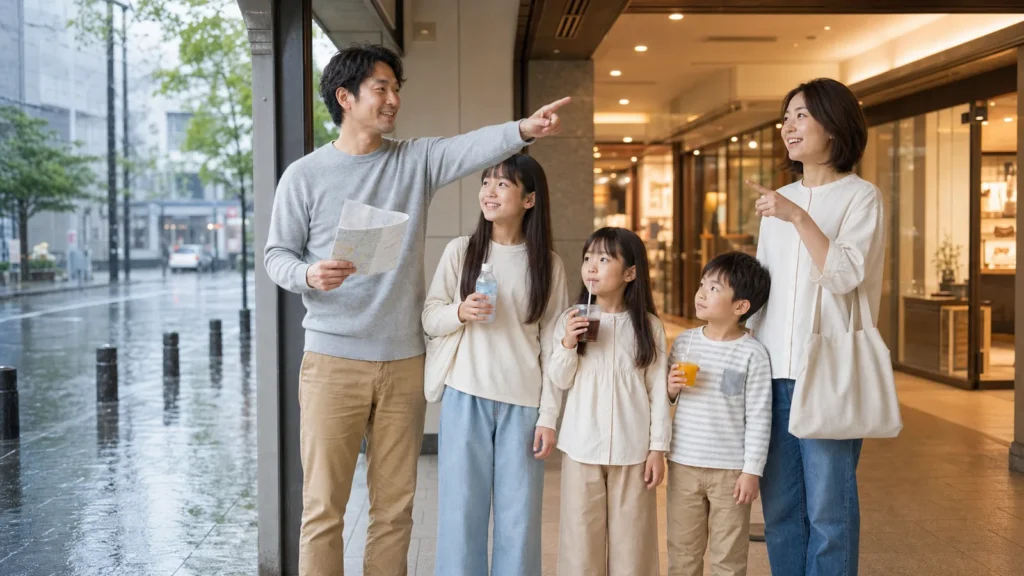
Family travel rarely follows the schedule perfectly.
A child may become tired. The weather may change. A restaurant may have a long line. A train transfer may take longer than expected.
When that happens, you can:
- remove one activity
- return to the hotel
- move to an indoor location
- buy drinks or a simple snack
- sit down before deciding what to do next
Changing the plan is not wasting the day.
Sometimes the small, unplanned moments become the memories children keep.
They may not remember every temple, station, or museum. They may remember the train ride, the convenience-store chicken, the hotel room, or the ice cream the family ate during a break.
Final Thoughts
Japan can be a great place to travel with children.
Trains, convenience stores, family restaurants, and public facilities make many parts of the trip easier. At the same time, crowded stations, long walks, unfamiliar food, and summer heat can use more energy than parents expect.
My children are 10, 8, and 6. Traveling with them has taught me that a successful family day does not need a perfect itinerary.
Choose one main activity. Leave time to rest. Buy the convenience-store chicken when everyone is hungry. Go inside when it is too hot.
The goal is not to complete every item on a list.
The goal is to return home with good family memories.
If you would like to see what ordinary life looks like for our family when we are not traveling, read Japanese Family Life: What Is Everyday Life Like in Japan?.
Comments