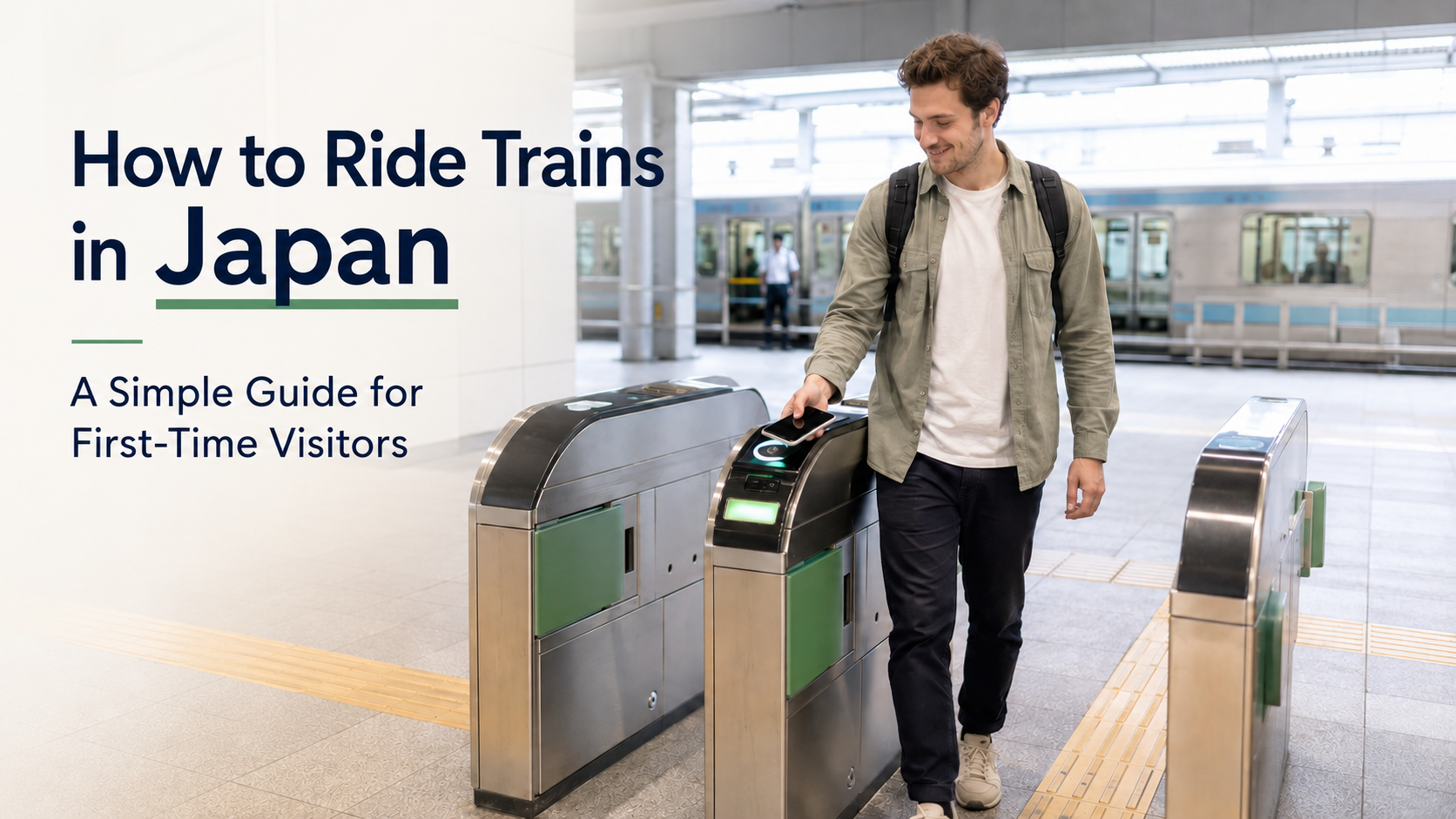
Hello, I’m Hirossy.
Japanese trains are convenient, punctual, and useful for traveling around cities such as Tokyo, Osaka, and Nagoya.
However, they can also feel confusing at first.
You may wonder:
- Which train should I take?
- Should I buy a ticket or use an IC card?
- How do I pass through the ticket gate?
- Are there any train manners I should know?
Don’t worry if you feel a little nervous.
Even Japanese people sometimes get confused at large stations. I do too.
In this guide, I will explain how to ride trains in Japan and introduce a few simple manners that will make your journey easier.
The Basic Steps for Riding a Train in Japan
The train system may look complicated, but the basic process is simple:
- Go to the station.
- Buy a ticket or prepare your IC card.
- Pass through the ticket gate.
- Find the correct platform.
- Wait in line and board the train.
- Get off at your destination.
- Pass through the exit gate.
Once you understand this flow, riding trains in Japan becomes much easier.
Should You Use a Ticket or an IC Card?
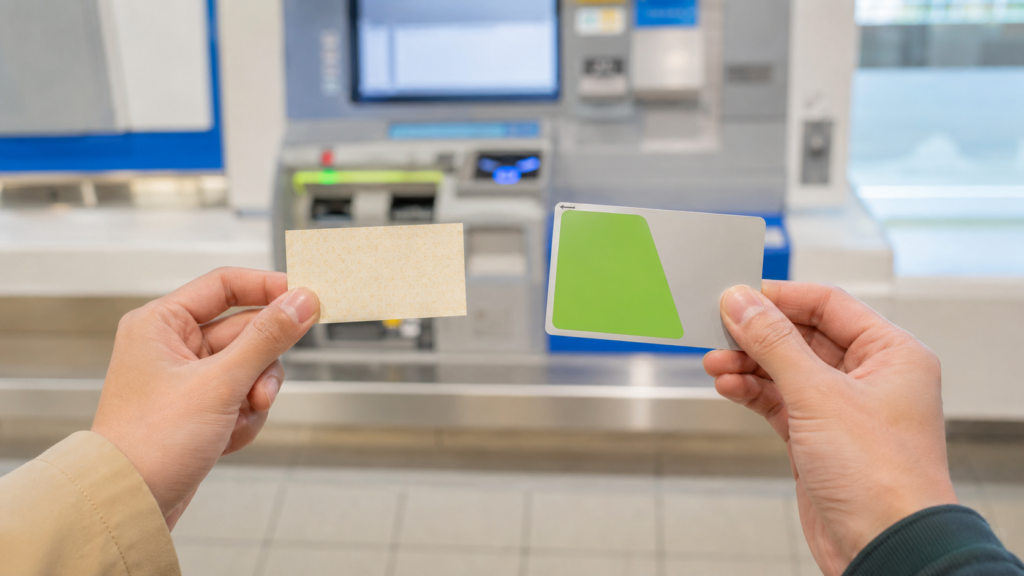
You can ride most local trains using either a paper ticket or an IC card.
Paper tickets are available from ticket machines inside the station. You select your destination or fare, pay for the ticket, and insert it into the ticket gate.
Remember to take the ticket when it comes out on the other side of the gate. You will need it again when you leave the station.
Paper tickets are fine for a single journey, but an IC card is usually more convenient.
Common IC cards include:
- Suica
- PASMO
- ICOCA
When you use an IC card, simply touch it to the reader at the ticket gate. Touch it again when you leave, and the correct fare will be deducted automatically.
You do not need to check the fare or buy a new ticket every time.
If you want to learn more about Suica, including how to add money and use it at ticket gates, read this beginner-friendly guide:
👉 How to Use Suica in Japan: A Beginner-Friendly Guide
My Recommendation: Use Suica on Your iPhone
If your iPhone supports it, I recommend adding Suica to Apple Wallet.
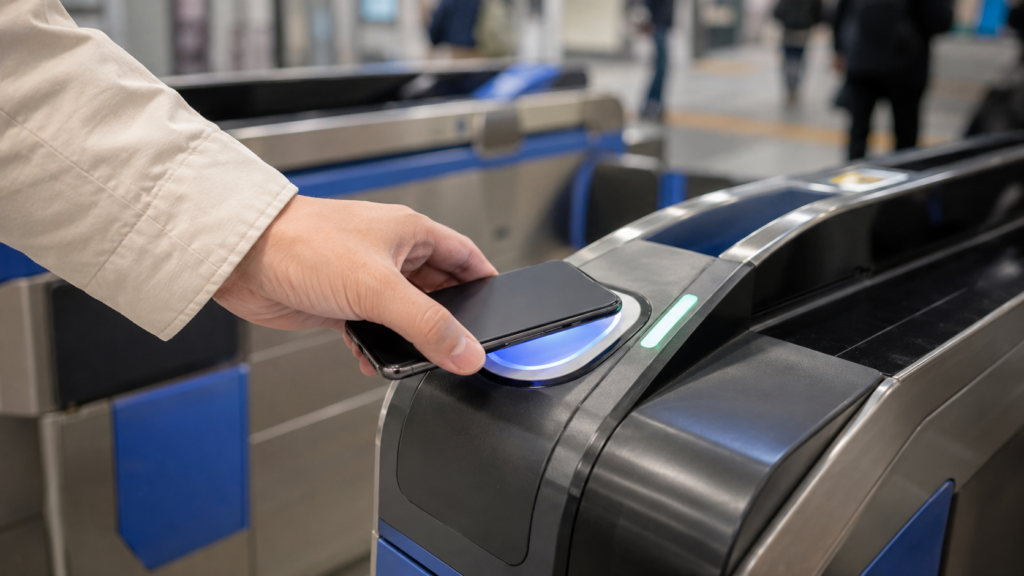
Once it is set up, you can enter and leave the station simply by tapping your iPhone at the ticket gate.
You do not need to open an app, unlock your phone, or use Face ID each time if Suica is set to Express Mode.
You can also check your balance and add money using your iPhone. Suica can be used not only for trains, but also on many buses and at convenience stores, vending machines, restaurants, and other shops.
I Was Nervous the First Time I Used Mobile Suica
When I first set up Mobile Suica on my smartphone, I understood how it was supposed to work.
But I was still nervous when I stood in front of the ticket gate.
“Can I really pass through without opening the app?”
“What if the gate suddenly closes?”
I held my smartphone over the reader.
Beep!
The gate opened immediately.
It worked so smoothly that I was a little surprised.
Now I use it without thinking, but I still remember how nervous I felt the first time.
If you are using Suica on your iPhone for the first time, you may feel the same way. But once it is set up correctly, you only need to tap your iPhone when entering and leaving the station.
For international visitors, Welcome Suica Mobile is a convenient option designed for travelers from overseas.
If you would like to know how to set it up, add money, and use it at ticket gates, read my detailed guide:
How to Use Welcome Suica Mobile on Your iPhone in Japan
Smartphone compatibility and available payment methods may depend on your device and country, so check the latest information before your trip.
If your smartphone is not compatible, don’t worry. You can still use a physical IC card or a paper ticket.
How to Find the Correct Platform
After passing through the ticket gate, look for signs showing the train line, direction, and platform number.
I recommend checking these four things:
- The name of the train line
- The direction or final destination
- The platform number
- Whether the train stops at your destination
The last point is important because some lines have local, rapid, and express trains. A faster train may pass through your destination without stopping.
Navigation apps such as Google Maps can also help. They often show the train line, departure time, platform, and transfer information.
However, large stations such as Tokyo Station and Shinjuku Station can still be difficult to navigate.
Even as a Japanese person, I sometimes stop and think:
“Am I going the right way?”
If this happens to you, don’t feel embarrassed. Check the signs again or ask a station staff member.
Let Passengers Get Off Before You Board
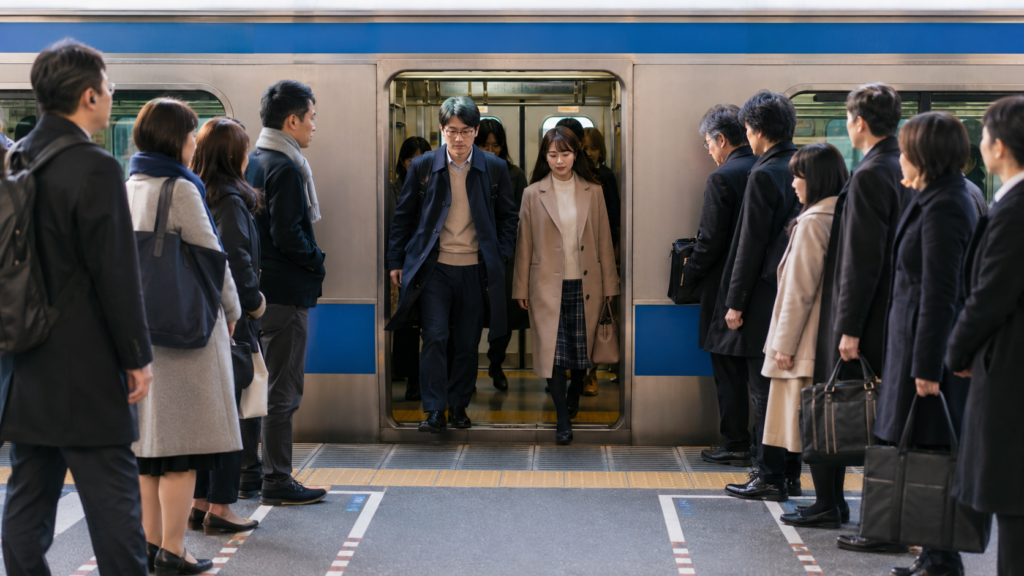
People usually wait in lines beside the train doors.
When the train arrives, do not stand directly in front of the doors. First, leave some space and let the passengers inside get off.
After they have left the train, you can board.
The simple rule is:
People getting off go first. People getting on go second.
Many platforms have lines or marks on the floor showing where to wait. Following these marks makes boarding easier for everyone.
Simple Train Manners to Remember
You do not need to memorize many complicated rules.
A little consideration for the people around you is usually enough.
Keep Your Voice Down
Japanese trains are often quiet.
You can talk with your family or friends, but try not to speak too loudly. Phone calls inside the train are also generally avoided.
Many passengers look at their smartphones, read, listen to music, sleep, or simply sit quietly.
When I ride a train with my children, I sometimes remind them:
“Use a quiet voice.”
Children naturally become excited when they go somewhere, so I understand that staying completely quiet is difficult. You do not need to be silent. Just pay a little attention to the volume of your voice.
Be Careful with Your Bags
Large bags and backpacks can take up more space than you may realize, especially on a crowded train.
If you are wearing a backpack, hold it in front of your body or place it on the luggage rack when possible. When sitting, keep your bag on your lap.
Do not place your bag on the seat next to you when other passengers may want to sit there.
If you are traveling with a large suitcase, try to keep it close to you so that it does not block the doors or aisle.
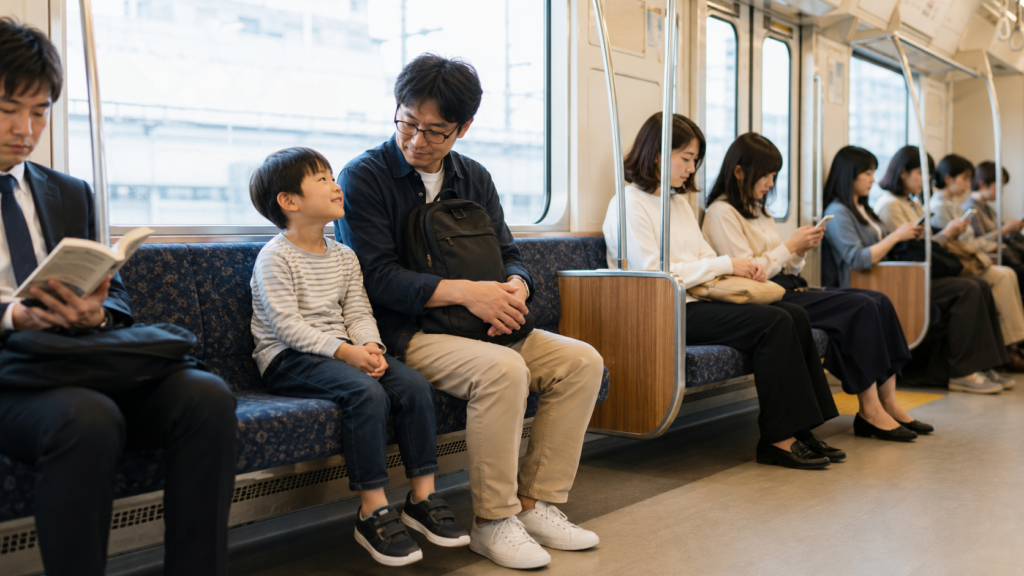
Do Not Put Shoes on the Seats
When I travel with my children, I also tell them not to put their shoes on the seats.
This may happen when a small child kneels on a seat to look out of the window.
If your child wants to kneel or stand on the seat, remove their shoes first. This keeps the seat clean for the next passenger.
It is a small rule, but many Japanese passengers pay attention to it.
Pay Attention to Priority Seats
Japanese trains have priority seats for passengers who may need them, including:
- Elderly passengers
- Pregnant passengers
- People with disabilities
- People with injuries
- Passengers with small children
If you are sitting and notice someone who may need the seat more than you, offering it is a kind thing to do.
Not every disability or health condition is easy to see, so it is also important not to judge other passengers too quickly.
Avoid Rush Hour If Possible
Trains in large cities can become extremely crowded during the morning and evening rush hours.
The busiest times depend on the city and train line, but weekday trains are often crowded when people are traveling to and from work or school.
If your schedule is flexible, traveling outside these periods can make your journey much more comfortable.
This is especially helpful if you are traveling with:
- Small children
- A baby stroller
- Large suitcases
- Several bags
Crowded trains are difficult even for Japanese passengers.
When I ride one, I sometimes think:
“This is really hard.”
Avoiding rush hour is one of the easiest ways to have a more comfortable train journey in Japan.
What Should You Do If You Get Lost?
If you are not sure which train or platform to use, ask a station staff member.
You do not need to speak perfect Japanese. Showing the name of your destination on your smartphone can make communication much easier.
Simple English may be enough:
- “Tokyo Station?”
- “Which platform?”
- “How can I get to Shinjuku?”
Station staff may use signs, maps, numbers, or gestures to help you.
Many Japanese people are not confident speaking English. I am still studying English too.
However, that does not mean people do not want to help.
A Small Memory from a Train Station
One day, I saw a foreign traveler drop a train ticket at a station.
I picked it up and wanted to say something in English, but I could not think of the right words quickly enough.
Instead, I said:
“Otoshimashita yo.”
This means:
“You dropped this.”
I handed the ticket back, and the traveler smiled at me.
Perhaps my Japanese was not understood perfectly. Still, my actions and facial expression communicated what I wanted to say.
It is a small memory, but it made me happy.
If you have trouble at a station in Japan, you may meet someone who wants to help—even if neither of you can communicate perfectly.
Final Tips for Riding Trains in Japan
Japanese train stations may look complicated, but you only need to remember a few basic points:
- Use a ticket, IC card, or Suica on your smartphone.
- Check the train line, direction, platform, and train type.
- Wait in line on the platform.
- Let passengers get off before you board.
- Keep your voice down inside the train.
- Hold your bags so they do not disturb other passengers.
- Do not put shoes on the seats.
- Avoid rush hour when possible.
- Ask station staff if you need help.
You may get lost once or twice, especially at a large station. That is completely normal.
Take your time, follow the signs, and do not be afraid to ask for help.
Once you understand the basic system, trains will become one of the easiest and most convenient ways to travel around Japan.
And if you use Suica on your iPhone for the first time, you may feel a little nervous when you approach the ticket gate.
I understand that feeling.
Just hold your iPhone over the reader and wait for the beep.
Your train journey in Japan has begun.

Comments