Hello, I’m Hirossy.
One thing that often surprises visitors to Japan is this:
Japanese convenience stores.
There are convenience stores in many countries.
But when people visit a convenience store in Japan, they may think:
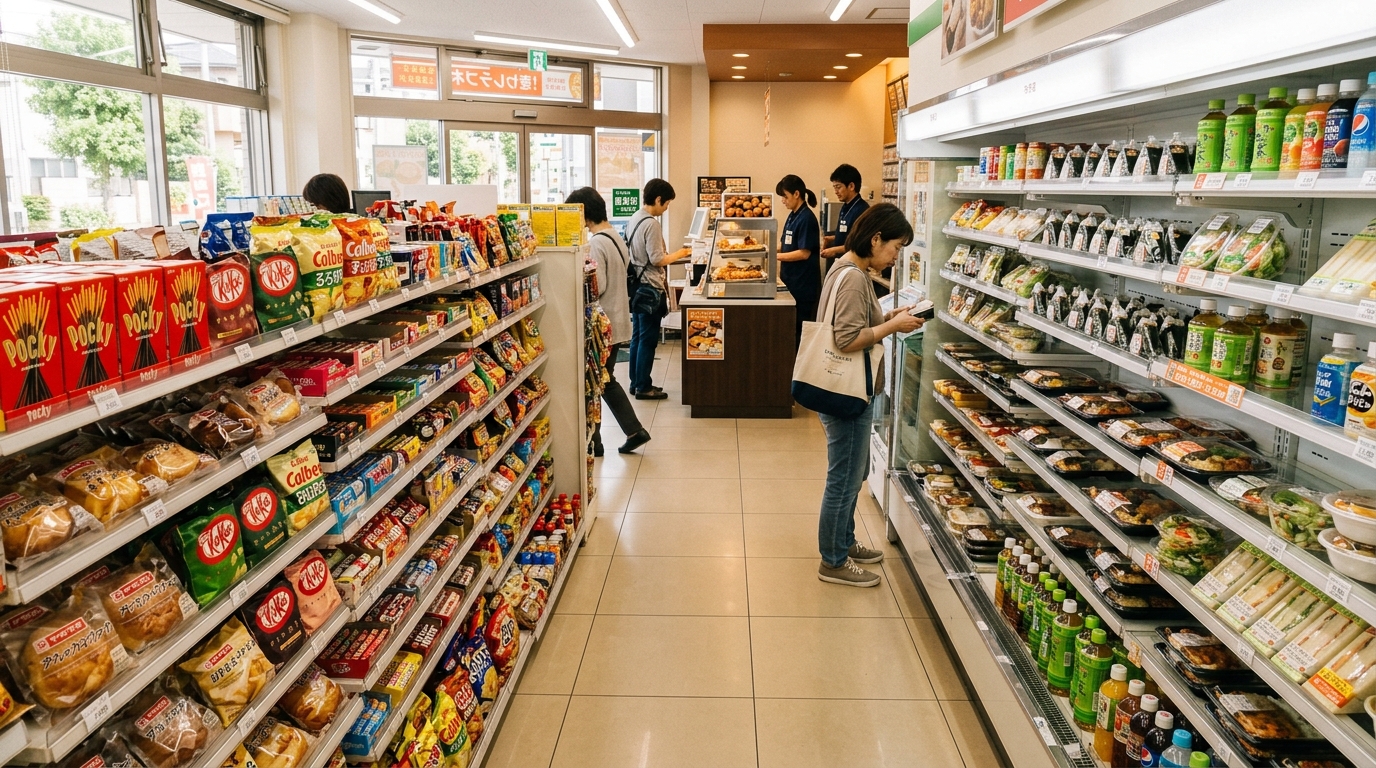
“Wow, it is brighter than I expected.”
“There are so many kinds of food.”
“The products are arranged so neatly.”
“This is not just a small shop.”
I’m just an ordinary Japanese dad, and I use convenience stores often in my daily life.
The convenience store I use most is Lawson.
The reason is a little practical.
When I use my Sumitomo Mitsui credit card, I can get points back.
For example, if I buy something for 1,000 yen, I may get 70 V Points back, depending on the conditions.
These points can be used like money.
One point is worth one yen.
I think point systems may exist in other countries too.
But in Japan, many people collect points at convenience stores, supermarkets, drugstores, and other shops.
This may be one reason why convenience stores are so closely connected to everyday life in Japan.
- Conclusion: Japanese Convenience Stores Are More Than Just Shops
- Convenience Stores Are Very Close to Daily Life in Japan
- Many Products Are Unique to Convenience Stores
- The Stores Are Bright and the Products Are Neatly Arranged
- Convenience Stores Are Also a Small Food Culture
- Convenience Stores Are Useful for Travelers Too
- Gentle Advice for Visitors to Japan
- Summary: Convenience Stores Show a Part of Everyday Japan
Conclusion: Japanese Convenience Stores Are More Than Just Shops
The reason Japanese convenience stores are amazing is not only because the food is good.
Of course, rice balls, bento boxes, bread, sweets, and hot snacks are very attractive.
But Japanese convenience stores are also:
small and useful places that support everyday life in Japan.
Some people buy breakfast there.
Some people buy lunch.
Some people buy drinks or sweets after work.
Some people buy daily items when they suddenly need them.
Some people use the ATM or copy machine.
Travelers may buy a quick meal or snack there.
For Japanese people, convenience stores are not really special places.
They are a natural part of daily life.
That may be why visitors from other countries wonder, “Why are they so convenient?”
Convenience Stores Are Very Close to Daily Life in Japan
In Japan, convenience stores can be found in many places.
You can find them near train stations, in residential areas, near offices, and along big roads.
Of course, it depends on the area.
In big cities, there are many convenience stores.
In rural areas, you may need a car to get to one.
Still, for many Japanese people, convenience stores are very familiar places.
For example, people may think:
“I want to buy a drink.”
“I need lunch.”
“I want to buy a snack for my children.”
“I need to make a copy.”
“I want to use an ATM.”
At times like these, convenience stores are very useful.
I often buy bread at a convenience store for lunch on workdays.
Supermarkets also sell bread, but I personally like convenience store bread more.
Convenience store bread has many flavors and styles.
There are also seasonal products, so it is fun to choose.
Many Products Are Unique to Convenience Stores
Convenience stores sell daily items and snacks.
Some of these products are similar to what you can find in supermarkets.
But if you visit a Japanese convenience store, I really recommend looking at these items:
- bento boxes
- rice balls
- bread
- sweets
- hot snacks
- steamed buns
- fried chicken
Many of these products are unique to each convenience store.
Seven-Eleven, Lawson, and FamilyMart all have their own popular products.
Even Japanese people sometimes say things like:
“I like Lawson’s sweets.”
“I like FamilyMart’s chicken.”
“I like Seven-Eleven’s bento boxes.”
Everyone has their own favorite.
In my case, I often go to Lawson.
The point system is one reason, but I also enjoy looking at the bread and sweets.
Recently, rice has become more expensive in Japan.
Maybe because of that, rice balls sometimes feel a little expensive for their size.
Of course, rice balls are a very Japanese food, and they are delicious.
But for my lunch, I often choose bread because it is usually cheaper and makes me feel full.
This kind of simple choice may also be a very normal part of Japanese daily life.
The Stores Are Bright and the Products Are Neatly Arranged
I once visited a convenience store attached to a gas station in California.
At that time, I was surprised because the atmosphere was very different from a Japanese convenience store.
Of course, stores are different depending on the country and area.
Convenience stores in other countries also have many good points.
But from my experience, many Japanese convenience stores feel bright, clean, and well organized.
Products are arranged neatly on the shelves.
Bento boxes, bread, and drinks are easy to see and choose.
For people visiting Japan for the first time, this neat and organized feeling may leave a strong impression.
In Japan, many shops care about cleanliness and product displays.
This is not only true for convenience stores.
You can also see this in supermarkets and drugstores.
Of course, not every store is perfect.
Sometimes stores are crowded.
Sometimes popular products are sold out.
Still, many Japanese convenience stores are designed so people can shop quickly and comfortably.
Convenience Stores Are Also a Small Food Culture
If I introduce Japanese convenience stores to people from other countries, I would really like them to look at the food.
Japanese convenience stores have many foods that feel very Japanese.
For example, rice balls are a very Japanese item.
They are made with rice and wrapped with seaweed.
Inside, there may be salmon, pickled plum, tuna mayo, or other fillings.
They are very convenient when you want a light meal during travel.
Bento boxes also come in many types.
There are fried chicken bento, grilled fish bento, curry, pasta, rice bowls, and more.
There are so many choices that you may be surprised they are sold at a convenience store.
Bread is also recommended.
Japanese bread may be a little different from bread in other countries.
Many Japanese breads are soft and fluffy.
There are sweet breads and savory breads too.
I often buy bread for lunch, so I always check the bread section.
Choosing one while thinking, “Which one should I get today?” is a small fun moment for me.
Sweets are also very popular.
You can find pudding, roll cake, cream puffs, seasonal desserts, and many other sweets.
Some of them are surprisingly high quality for convenience store products.
After a long day of work or housework, many people buy convenience store sweets as a small treat.
As an ordinary Japanese dad, I understand that feeling very well.
Convenience Stores Are Useful for Travelers Too
For travelers in Japan, convenience stores are very useful.
Maybe you do not want to go to a restaurant, but you want something small to eat.
Maybe you feel hungry at night in your hotel.
Maybe you need a simple breakfast before leaving early in the morning.
In those situations, convenience stores are very helpful.
You can buy drinks, rice balls, bread, bento boxes, sweets, cup noodles, and more.
Depending on the store, there may also be an ATM, copy machine, ticket machine, or restroom.
However, not every convenience store has a restroom.
Even if there is a restroom, it may be better to ask the staff before using it.
Some convenience stores also have eat-in spaces.
But not all stores have them.
In Japan, eating while walking or eating in front of a shop is not always common.
In some tourist areas, eating while walking is part of the fun.
But in residential areas or near stations, it may be better to be a little careful.
These small rules can be different depending on the area or store.
If you are not sure, it is a good idea to look around and see what other people are doing.
Gentle Advice for Visitors to Japan
If you come to Japan, please do not think of convenience stores as just small shops.
Try taking a little time to look around.
I especially recommend the food section.
Rice balls, bread, sweets, and hot snacks are easy ways to enjoy Japanese convenience stores.
You do not need to choose the most famous item at first.
It is fun just to choose something that looks interesting to you.
However, some product names may be written only in Japanese.
If you have allergies or food you cannot eat, it is safer to use a translation app or ask the staff.
Also, plastic shopping bags often cost extra in Japan.
It is useful to carry a small reusable bag.
Many convenience stores accept cash, credit cards, and electronic payments.
In Japan, many people also use point cards or point apps.
But if you are a traveler, you do not need to worry too much about that.
Just enjoy it as a small experience of Japanese daily life.
Summary: Convenience Stores Show a Part of Everyday Japan
Japanese convenience stores are not only places to buy food and drinks.
They are places where people buy lunch for work, snacks for children, quick meals during travel, or daily items they suddenly need.
They are a very natural part of everyday life in Japan.
For me, a convenience store is not a special tourist spot.
But it is a familiar place that helps me in daily life.
I think visitors feel Japanese convenience stores are amazing because they include many small parts of Japanese life.
You can see food culture, cleanliness, convenience, and everyday ideas all in one place.
If you visit Japan, please try stopping by a convenience store.
You may see a normal side of Japan that is a little different from famous tourist spots.
I hope it makes Japan feel a little closer to you.
Comments