Hello, I’m Hirossy.
When you travel in Japan, you may see places with red torii gates, or places with big Buddha statues.
At that time, you may wonder:
“Is this a shrine or a temple?”
“What is the difference between shrines and temples in Japan?”
For Japanese people, shrines and temples are familiar places.
But to be honest, not all Japanese people remember the rules perfectly.
Even I, as an ordinary Japanese dad, sometimes think, “Wait, what is the correct way to pray again?”
So in this article, I would like to explain the difference between shrines and temples in a simple way for travelers visiting Japan.
- Conclusion: Shrines Are Shinto Places, and Temples Are Buddhist Places
- What Is a Shrine?
- What Is a Temple?
- How to Tell the Difference Between a Shrine and a Temple
- The Ways to Pray Are a Little Different
- Basic Manners at a Shrine
- Basic Manners at a Temple
- Shrines and Temples Are Part of Daily Life in Japan
- Friendly Advice for Travelers
- Summary
Conclusion: Shrines Are Shinto Places, and Temples Are Buddhist Places
To put it simply:
Shrines are places for Shinto gods.
Temples are places connected to Buddhism.
Shinto is an old Japanese belief that respects gods and nature.
Buddhism originally came to Japan from other countries.
This may sound a little difficult, but when you are traveling in Japan, you can remember it like this:
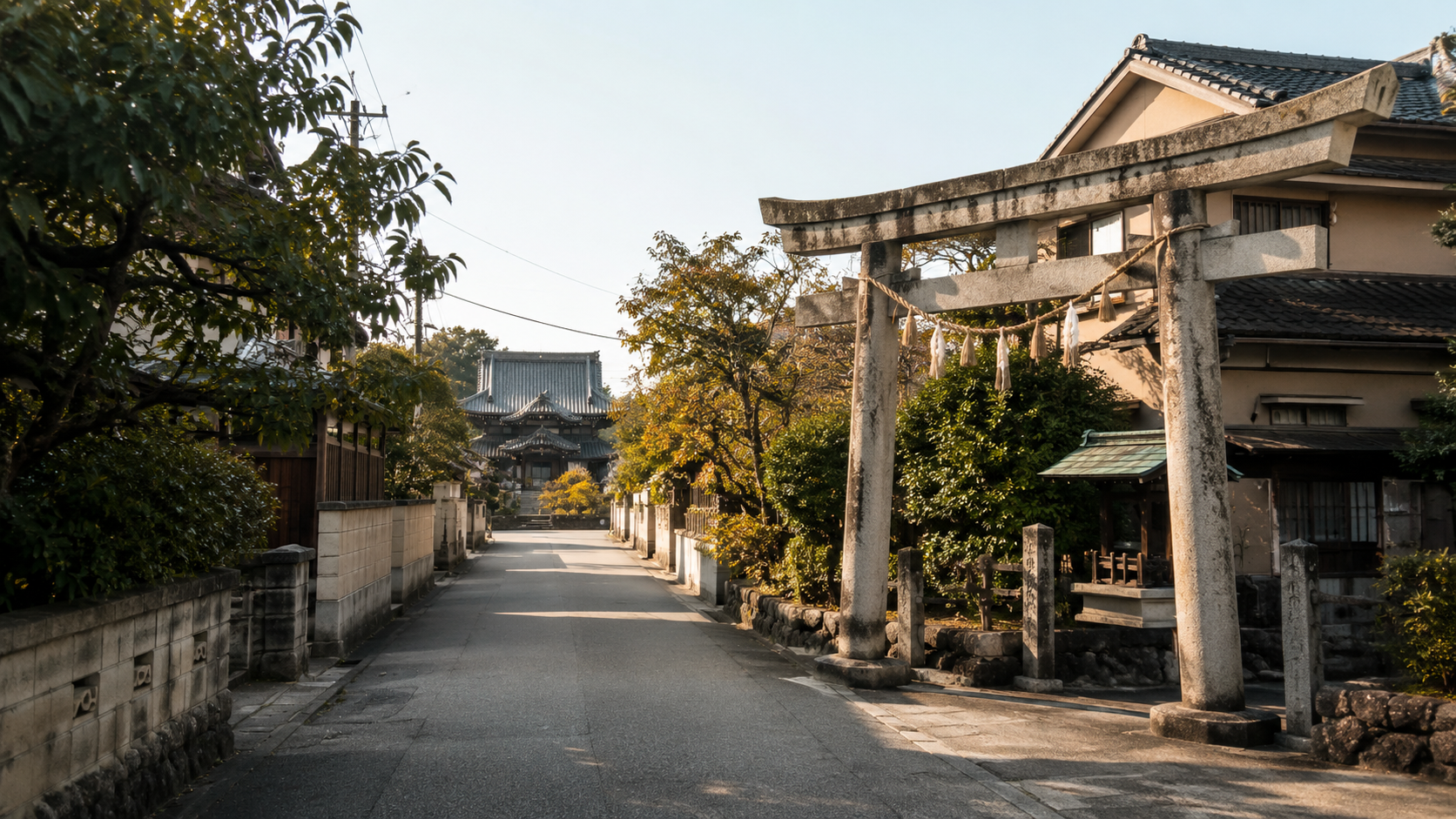
If you see a torii gate, it is often a shrine.
If you see Buddha statues, graves, or Buddhist monks, it is often a temple.
There are some exceptions, of course.
But for travelers, this is one of the easiest ways to tell the difference.
What Is a Shrine?
A shrine is a place where Shinto gods are enshrined.
In Japan, there has long been a belief that gods can exist in nature.
For example, mountains, rivers, the sea, trees, and the sun can be connected to gods.
At many shrines, you will see a torii gate at the entrance.
A torii gate is like a gate to a sacred place.
Many Japanese people visit shrines at the beginning of the New Year.
This is called hatsumode.
Hatsumode means the first shrine visit of the year.
People pray for health, happiness, and good luck for the new year.
I often go to a shrine for hatsumode.
When I visit a shrine with my family at New Year, I feel, “A new year has started.”
What Is a Temple?
A temple is a place connected to Buddhism.
At temples, you may see Buddha statues or Buddhist monks.
Many temples also have graves.
Some famous temples in Japan are Kinkaku-ji and Kiyomizu-dera in Kyoto.
When I was a student, I went to Kyoto on a school trip.
At that time, I visited Kinkaku-ji and Kiyomizu-dera.
Kinkaku-ji looked very golden, and it left a strong impression on me as a child.
Kiyomizu-dera also has a large wooden stage, and I remember thinking, “People in the past made such an amazing building.”
If you travel to Kyoto, you will probably have many chances to visit famous temples.
How to Tell the Difference Between a Shrine and a Temple
When you are traveling, these simple points may help you.
If There Is a Torii Gate, It Is Often a Shrine
Many shrines have a torii gate at the entrance.
Some torii gates are red, and some are made of wood.
When you see a torii gate, you may feel, “This is the entrance to a sacred place.”
If There Is a Buddha Statue, It Is Often a Temple
Many temples have Buddha statues.
Some are big, some are small, and some are gold.
Each temple has its own atmosphere.
If You See Buddhist Monks, It Is Often a Temple
At temples, you may see Buddhist monks.
Monks are connected to Buddhism.
At shrines, you may see Shinto priests or shrine maidens instead.
The Ways to Pray Are a Little Different
The way to pray is also a little different at shrines and temples.
But the important thing is this:
You do not have to remember everything perfectly.
If you act quietly and respectfully, it is usually okay.
I am Japanese, but I do not always remember the rules perfectly either.
Sometimes I think, “Was it two bows, two claps, and one bow at a shrine?”
So if you are visiting Japan from another country, please do not worry too much.
Basic Manners at a Shrine
At a shrine, some people bow lightly before passing through the torii gate.
This is a way to show respect before entering a sacred place.
After that, there is often a place called temizuya.
This is a water purification area.
People use water to clean their hands and sometimes their mouth before praying.
You may see a ladle there, although some places have changed the style recently.
When praying at a shrine, the common way is called:
Two bows, two claps, and one bow.
In simple steps:
- Bow two times.
- Clap your hands two times.
- Put your hands together and pray or give thanks.
- Bow one more time.
However, some shrines may have slightly different customs.
If there is a sign, it is a good idea to check it.
Basic Manners at a Temple
At a temple, people usually do not clap their hands like they do at a shrine.
Instead, people put their hands together quietly and pray.
Because temples are Buddhist places, the atmosphere is a little different from shrines.
Some shrines feel open and bright, while many temples feel calm and peaceful.
When you visit a temple, you can enjoy the buildings, gardens, and Buddha statues quietly.
Shrines and Temples Are Part of Daily Life in Japan
In Japan, shrines and temples are religious places, but they are also part of daily life and culture.
For example, many people visit shrines for hatsumode at New Year.
Some families visit shrines for Shichi-Go-San, a traditional event to celebrate children’s growth.
On the other hand, people may visit temples for family graves or Buddhist memorial services.
Also, when people travel to Kyoto or Nara, they often visit famous temples as sightseeing spots.
Many Japanese people visit both shrines and temples.
This may feel a little surprising to people from other countries.
But in Japan, both shrines and temples naturally exist in our culture and daily life.
Of course, it depends on the family, the region, and the person.
Some people visit them every year.
Other people visit them mainly when they travel.
Friendly Advice for Travelers
When you visit shrines or temples in Japan, you do not need to remember every small rule perfectly.
I think the most important thing is to show respect.
Try not to speak too loudly.
Do not take photos where photography is not allowed.
Do not enter areas that are closed to visitors.
Try not to disturb other people who are praying.
If you keep these simple points in mind, you can enjoy your visit more comfortably.
If you do not know what to do, you can quietly watch what other people are doing and follow them.
Many places also have signs, so checking them can help.
Shrines and temples are not only sightseeing spots.
They are also places where you can feel a little of Japanese life, culture, and history.
Summary
To explain the difference simply:
Shrines are Shinto places.
Temples are Buddhist places.
If you see a torii gate, it is often a shrine.
If you see Buddha statues or Buddhist monks, it is often a temple.
The manners are a little different, but you do not have to be perfect.
Even I, as a Japanese person, sometimes forget the details.
The important thing is to visit quietly and respectfully.
When you travel in Japan and see a shrine or temple, I hope you will try visiting it.
You may feel something about Japanese life and culture that you cannot learn only from a travel guide.
Shrines and temples are places that can make Japan feel a little closer to you.
Comments